
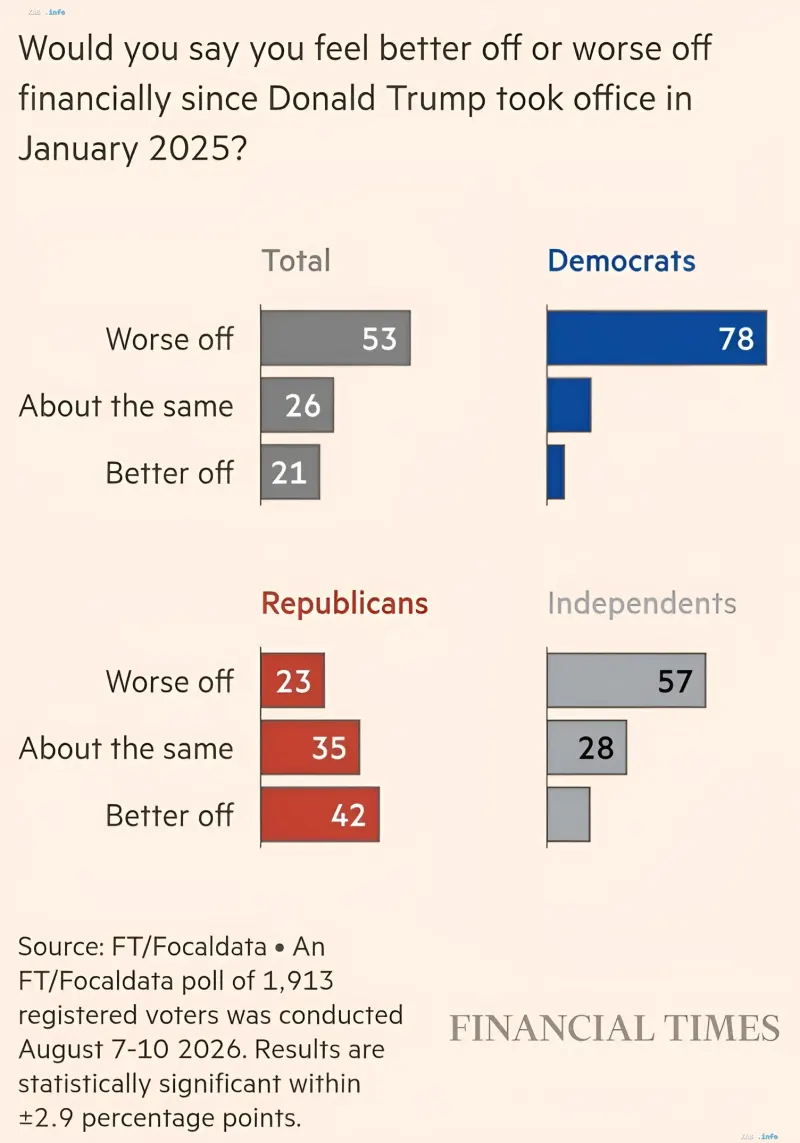
On August 16, 2026, just three months before the critically important midterm congressional elections, the influential publication Financial Times released the results of a large-scale sociological study revealing a deep divide between the economic policy of the Donald Trump administration and the actual situation in US households. According to the poll conducted by the Focaldata analytics center, 53% of registered voters stated that their personal financial situation has worsened since the beginning of the head of state's second presidential term in January 2025.
Structural Crisis: From Inflation to Geopolitics
Macroeconomic analysis of the situation in the US as of August 2026 points to a combination of factors that have caused stagnation in citizens' real incomes. The key driver of dissatisfaction has been "sticky" inflation: according to the Bureau of Labor Statistics, the Consumer Price Index (CPI) in July 2026 was 3.4% year-on-year, which remains above the Federal Reserve's target indicators. Economists link this phenomenon to the White House's hardline protectionist policy. The introduced import tariffs led to a 6.5% increase in the Producer Price Index (PPI), which businesses passed on to the end consumer.
An additional factor putting pressure on American budgets was geopolitical tension. The prolonged military campaign by the administration against Iran, unfolding in the Middle East, triggered a surge in global energy prices. The cost of gasoline at US retail stations exceeded the psychological mark of $3.50 per gallon, which significantly increased logistics costs and the price of consumer goods.
Electoral Erosion: Rift Within the Republican Party
Poll data demonstrates an alarming trend for the ruling party. Pessimism regarding the economic situation has gone beyond the traditional electorate of the Democratic Party. While 78% of respondents among Democrats stated that incomes were falling, among independent voters this figure was 57%. Most indicative is the rift within the Republican Party's base: almost a quarter (25%) of Trump's supporters admitted that they are living worse off since he took office. In total, 64% of respondents disapprove of the administration's measures to combat inflation, and the overall approval rating of the president's economic policy has dropped to 45%.
Financial Asymmetry: Growth of the President's Wealth
Against the backdrop of the deteriorating well-being of the majority of citizens, an opposite trend is observed in the assets of the head of state. According to financial audit data published by Forbes magazine, Donald Trump's net worth in 2026 reached the mark of $6.5 billion. During the period from January 2025, the president's wealth increased by almost a third, amounting to a growth of $1.4 billion. Analysts note that the main contribution to this growth was made not by traditional business assets, but by new investment projects: the World Liberty Financial cryptocurrency fund, shares of the Trump Media & Technology Group (Truth Social), and the growth in operating profit of the golf resort network.
Contradictory Data
A debate has arisen between supporters and critics of the administration regarding the interpretation of the poll data and financial reports. Trump's supporters argue that the growth of the president's personal capital is an indicator of overall investor confidence in the American economy and that current difficulties are temporary, caused by external shocks. They also point out that the poll was conducted during the peak of fuel prices, which could have distorted the perception of long-term financial prospects.
However, independent economists and representatives of the Democratic Party insist that the correlation between the growth of Trump's assets and the decline in citizens' incomes indicates a systemic bias in resource distribution. They emphasize that 55% dissatisfaction with the president's work on the economy is a direct signal of the inefficiency of current fiscal policy, which, in their opinion, works for a narrow circle of elites, ignoring the interests of the middle class.
Political Consequences Ahead of the Elections
The publication of Financial Times data in August 2026 is of critical importance for the election campaign. The Democratic Party, using these figures, has for the first time in the last two years seized the initiative in matters of economic management. In current ratings for the midterm elections on November 3, Democrats are ahead of Republicans with a rating of 44% against 39%. If the administration does not take radical steps to stabilize prices and reduce geopolitical tension, Republicans risk losing control of the House of Representatives, which could lead to a legislative deadlock in Congress.