
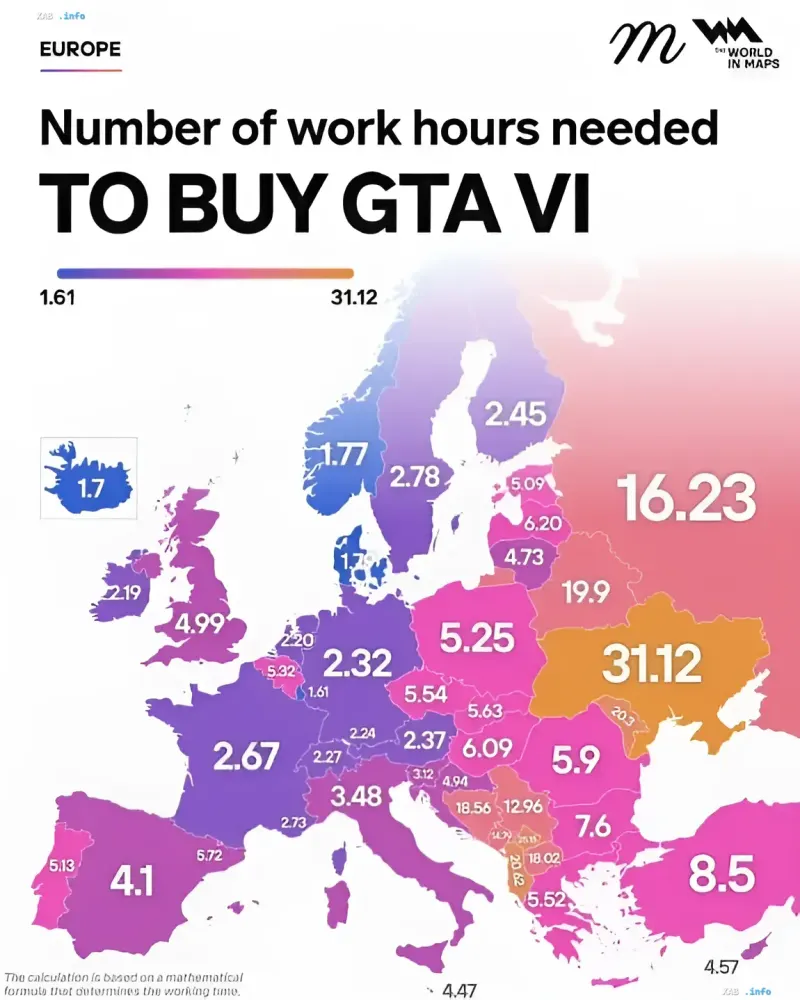
The modern entertainment industry demonstrates a global gap in living standards. The World in Maps project, together with the Maven Mapping analytics community, has published a study that vividly illustrates the purchasing power of the population in European countries. As an accessibility index, a hypothetical economic marker was chosen — the number of working hours required to purchase a standard digital release costing $79.99. The benchmark price taken is the base cost of the anticipated media franchise GTA VI.
The results of the study turned out to be a harsh reflection of the current economic reality. Ukraine took the last place in this list, recording the highest calculated number of working hours. This means that to acquire one unit of a digital product, a resident of the country must spend more time than any other resident of the countries included in the rating.
Accessibility Rating: from Switzerland to Ukraine
The authors of the study compared the retail price of a digital product with indicators of the national median net (after-tax) salary, as well as the actual duration of the working month. The resulting table demonstrates a colossal gap between Western, Northern, and Eastern Europe.
The leaders of the rating are countries with high incomes and a developed economy:
- 🇨🇭 Switzerland: 2.66 hours.
- 🇱🇺 Luxembourg: 3.20 hours.
- 🇩🇰 Denmark: 3.45 hours.
- 🇬🇧 United Kingdom: 4.27 hours.
- 🇩🇪 Germany: 4.74 hours.
The situation changes radically when moving to Eastern European countries and the CIS. The gap in indicators becomes critical:
- 🇵🇱 Poland: 11.50 hours.
- 🇷🇴 Romania: 17.64 hours.
- 🇧🇬 Bulgaria: 18.77 hours.
- 🇹🇷 Turkey: 23.52 hours.
- 🇷🇺 Russia: 26.60 hours.
- 🇽🇰 Kosovo: 29.86 hours.
- 🇺🇦 Ukraine: 32.11 hours.
Economic Mathematics and Methodology
It is important to understand that the calculations were not based on gross (before-tax) salaries, but on the basis of net disposable income. This allows for a more accurate reflection of the real financial capabilities of citizens. Initial versions of the infographics, relying on gross rates, showed a figure of 31.12 hours for Ukraine, however, the adjusted index, taking into account taxes, increased this figure to 32.11 hours.
The significant number of working hours required for Ukrainians to purchase a hypothetical unit of goods is explained by a combination of macroeconomic factors. The key ones are macro-financial instability and the current level of official median salaries, which in dollar and euro equivalents remains lower than in Central and Southern European countries.
The Problem of Lack of Regional Diversification
The main driver of this situation is the pricing policy of international publishers. Large companies releasing software and digital content generally fix the cost of flagship releases in a stable currency (dollars or euros) for the entire European region.
At the same time, they do not take into account local purchasing power parity (PPP). As a result, the nominal cost of the product in the equivalent of national currencies remains consistently high for markets with medium and low income levels. For a resident of Switzerland, $80 is a trifling amount covered by a couple of hours of work, whereas for a resident of Ukraine, it is a significant part of the monthly budget, requiring more than a day and a half of work.


