
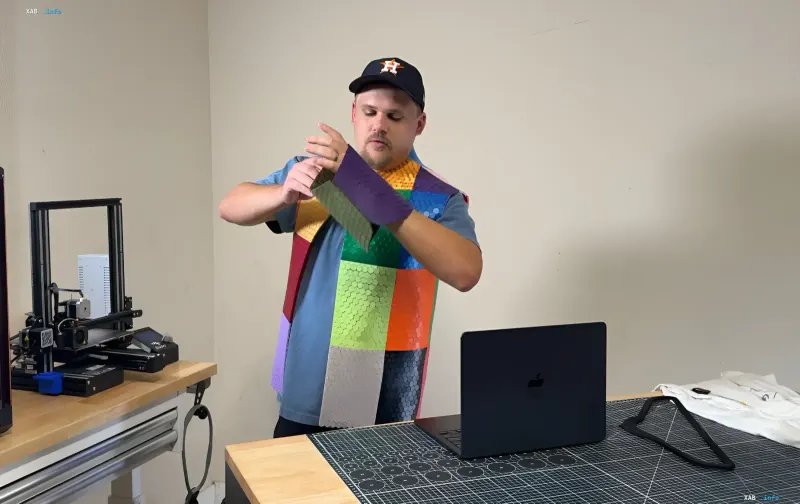
The world of additive technologies continues to amaze. This time, the experiment went beyond the usual prototypes and spare parts. Popular American tech blogger Matthew Tregan set himself an ambitious task: to create a full set of clothing and accessories exclusively using 3D printing.
The result was a large-scale project in which ten items were developed and printed. The list included a shirt, shorts, shoes, socks, a belt, a hat, a wallet, a bag, a tie, and even glasses. The experiment allowed not only to assess the capabilities of modern printers but also to analyze the economic feasibility of home clothing production.
The Price: Time and Resources
The analysis revealed a significant difference between the cost of raw materials and the price of equipment. Direct costs for thermoplastic filament amounted to only about $100. However, to implement the project, a modern and expensive Prusa Core 1L printer was required, which retails for $1,999.
Time costs turned out to be even more impressive. The digital modeling stage took 33 hours, and the total printing time reached 560 hours. This highlights that, despite the cheapness of plastic, the process of producing clothing on a 3D printer remains extremely labor-intensive.
Engineering Successes and Failures
From a technical point of view, the experiment demonstrated mixed results. The most successful element of the wardrobe was recognized as the conceptual Waveform shoes, created based on licensed designs by designer Steven Dranx. Experts highly rated this model for its ergonomics and durability, proving that 3D printing is capable of creating functional footwear.
The shirt also turned out to be a successful solution. A flexible structure with a hexagonal pattern was used for its manufacture, which allowed obtaining a product that resembles fabric in its properties. In the project photos, you can see Matthew Tregan trying on these elements, demonstrating their flexibility and ability to take the shape of the body.
At the same time, creating the lower part of the clothing revealed key shortcomings of home 3D production. The finished shorts turned out to be too stiff and unsuitable for everyday use. The problem lay in the author's lack of professional skills in pattern making and a deep understanding of the specifics of plastic behavior when printing large volumetric parts.
Evolution of Technologies
The author published all technical models and drawings of the project in the open access on the MakerWorld platform, providing the engineering community with the opportunity for further analysis and improvements.
Experts note that over the last 10 years, technologies have made a significant leap forward. If in 2015 at the Project Runway competition designers could only create rigid decorative elements, today home devices are capable of forming full-fledged flexible structures.
However, despite impressive achievements, at the current stage of development, the technology cannot be considered a full-fledged replacement for the traditional sewing industry and classic textile equipment. Matthew Tregan's experiment became a vivid proof that 3D printing of clothing is a reality, but the path to mass implementation is still long.


