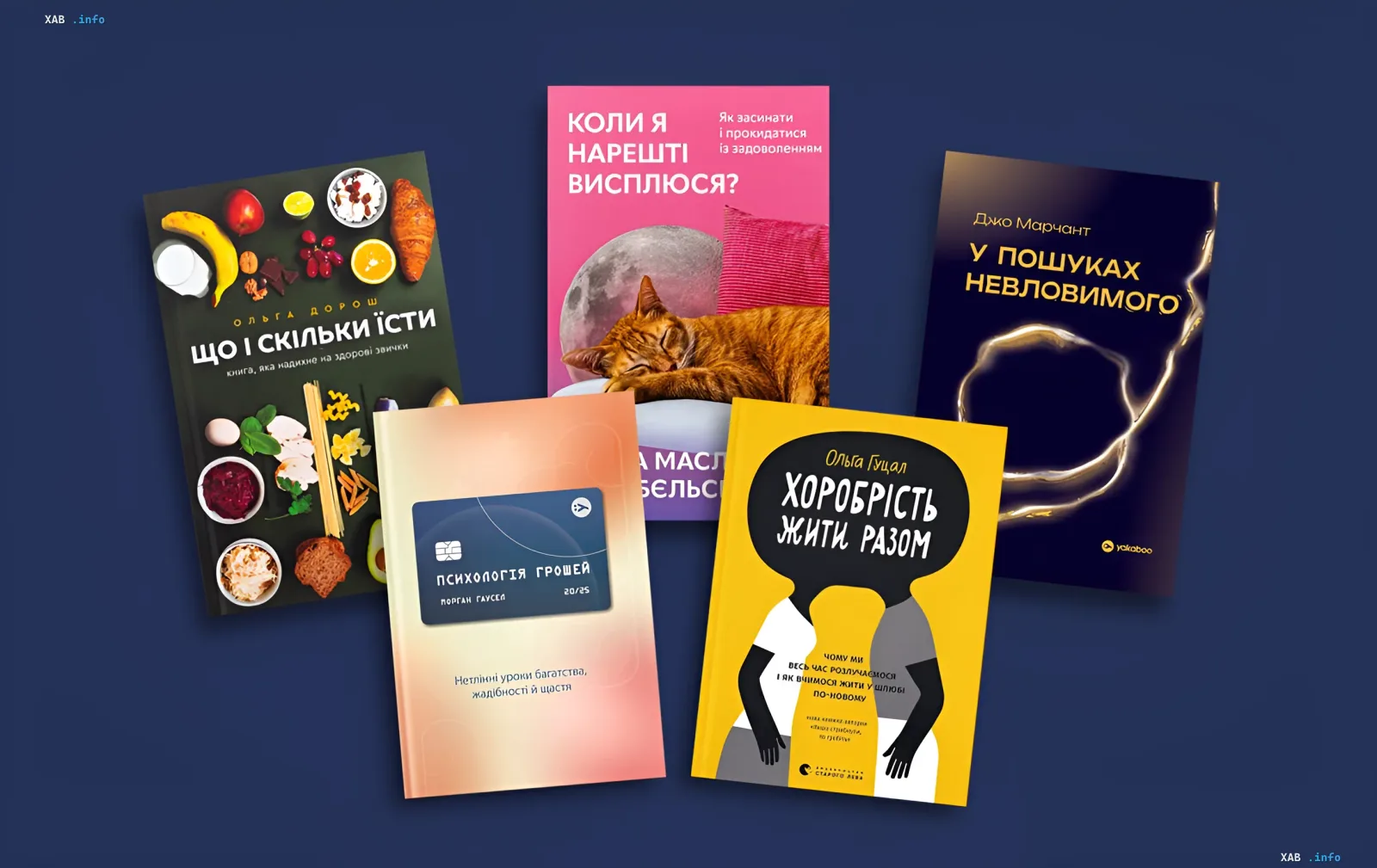
In school we memorized formulas, rules, and dates, but we rarely got answers to the questions that truly shape everyday life: how to handle money, how to fix your sleep, how to build relationships, and how to eat without extremes. It is precisely this gap that five books try to fill, a selection that the Styler editorial team compiled together with the national book platform Yakaboo. They are united by a single idea: adult independence is not a set of textbook facts, but a set of practical skills that can and should be mastered consciously, relying on science and experience rather than trendy advice.
Time, Consciousness, and the Science of the 'Now'
We are used to planning the future, remembering the past, and complaining that we never have time to live in the present — but what is 'now' from a scientific point of view? British science journalist Jo Marchant, in her book In Search of the Ungraspable, explores how the human brain creates the sense of time and continuous reality, drawing on physics, neuroscience, psychology, and philosophy. The author leads the reader from cosmology and quantum mechanics to memory, attention, and the peculiarities of consciousness, explaining complex concepts without a textbook tone. Marchant holds a doctorate in genetics and has worked in science journalism for many years, which allows her to make the complex accessible. According to the publication, the book made the list of the best new popular science titles of February 2026 as chosen by New Scientist — it is a pick for those who want to understand what science actually knows about our mysterious 'now,' rather than just hearing yet another piece of advice to 'live in the moment.'
The Psychology of Money: Why Finance Is Not Just Numbers
We study mathematics in school for years, yet the ability to handle money is somehow often left to self-study. Morgan Housel, in The Psychology of Money, explains why financial decisions depend not only on numbers and knowledge: they are influenced by our experience, fear, ambitions, habits, and even our ideas about what a successful life should look like. In separate short sections, the author examines savings, compound interest, risk, the role of luck, and the difference between the ability to earn and the skill to keep. Instead of a universal get-rich-quick scheme, Housel offers something less flashy but more useful — learning to think long-term and not to measure your own well-being by other people's standards. Housel has written about finance and investing for many years and has been awarded professional prizes in business journalism, and The Psychology of Money has become an international bestseller translated into dozens of languages.
Sleep as a Basic Adult Skill
'I'll catch up on sleep over the weekend' is perhaps one of the most persistent promises adults make to themselves, even though sleep does not work like a debt that can be endlessly postponed. Biologist Olga Maslova and Nika Belskaya, in the book When Will I Finally Get Enough Sleep?, explain how biological clocks and circadian rhythms work, what chronotypes are, and why there is no single correct schedule that fits everyone. The authors address practical questions: is it useful to nap during the day, how to survive jet lag, why the bedroom needs darkness, and why you should not try to turn a 'night owl' into someone who voluntarily wakes up at five in the morning. Olga Maslova is a candidate of biological sciences and a science popularizer, while Nika Belskaya is a geneticist and a consultant on sleep and healthy longevity; both worked as trainers for the 'School of Longevity' project, dedicated to a healthy lifestyle without extremes. This is not a book about a magical evening ritual, but about a basic adult skill — understanding your own body's needs and stopping the fight against it.
The Courage to Live Together: Relationships Between Adults
We somehow learn to fall in love on our own, but agreeing on money, personal boundaries, household life, and the rules of shared living turns out to be much harder. Olga Hutsal, in The Courage to Live Together, writes about the relationships of self-sufficient adults for whom traditional ideas about marriage no longer always provide answers to practical questions. Drawing, in particular, on her observations of a well-known business environment, the author examines why outwardly successful people can repeatedly fail at partnership. The book talks about the family budget, personal boundaries, a conditional 'marriage contract,' conflicts, and the need to occasionally revisit agreements when the people or their circumstances change; Hutsal also speaks separately about situations in which a relationship ends and about the possibility of divorcing with dignity. This is not an instruction manual for creating a 'perfect couple,' but a conversation about a skill that is rarely taught anywhere: how to remain two separate adults while simultaneously building a shared life.
Nutrition Without 'Good' and 'Forbidden'
Another thing we do every day, even though we do not always start to understand it systematically, is food. Nutritionist Olga Dorosh, in the book What and How Much to Eat, proposes moving away from the endless division of foods into 'good' and 'forbidden' and first understanding what the body actually needs. The author explains the principles of a balanced diet and examines popular nutrition myths, shifting the focus from prohibitions to understanding your own needs. Taken together, the five books form not a strict course but a set of tools: from the science of time and the psychology of money to sleep, relationships, and nutrition — that is, the very areas in which school, by the admission of the selection's own authors, never taught us.