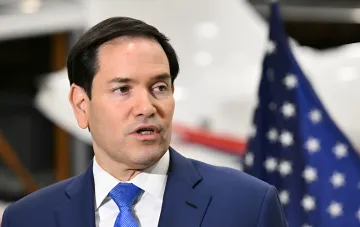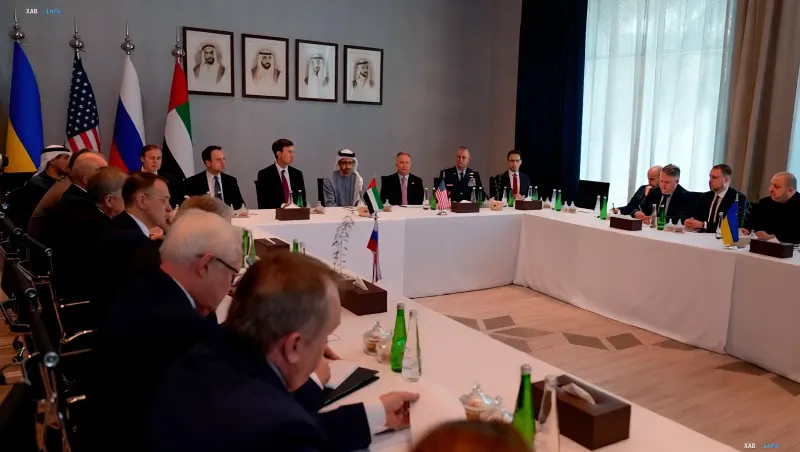
On November 10, closed-door trilateral talks involving Russia, Ukraine, and the US resumed in the capital of the United Arab Emirates, having been interrupted since February. According to a TASS correspondent, the first session on day one lasted about four and a half hours, including a break. The second round of consultations is scheduled for Wednesday, November 11. US Secretary of State Marco Rubio, who was in Paris at the time for a G7 foreign ministers meeting, called the first day "very productive," Reuters reports. Meanwhile, American negotiators as well as representatives of the Russian and Ukrainian delegations made no public statements after the session concluded.
Composition of Delegations and Meeting Format
The Russian delegation that arrived in Abu Dhabi turned out to be larger than the February one. New participants include the head of the FSB Fifth Service, Alexei Komkov, and his deputy, Dmitry Minaev; the Fifth Service is responsible for the agency's operations abroad. For the first time, the delegation included Russian Deputy Foreign Minister Sergei Ryabkov (along with another deputy minister, Mikhail Galuzin) and Deputy Head of the General Staff Information Directorate Alexander Zorin. "Our delegation has become larger and even more professional," commented the head of the Russian delegation, Vladimir Medinsky, without explaining the appearance of the new participants. The Ukrainian delegation was led by Rustem Umerov, who stated that he was authorized by President Volodymyr Zelenskyy to discuss all issues that Ukrainians expect solutions for, "to put an end to this war." Seated in the center of the table were US Presidential Special Envoys Steven Witkoff and Jared Kushner, who met in October first with Zelenskyy and then with Vladimir Putin. NATO Commander US General Alexus Grynkewich was also present in the room.
What Was Discussed on the First Day
According to Jared Kushner, the US has a number of constructive proposals to achieve progress in the peaceful settlement, and President Donald Trump is "firmly committed to achieving peace." "He asked us to make additional efforts to find a solution that will not only end the war, but also allow both parties to take much stronger positions," Kushner said, adding that the parties are "taking what worked," analyzing failures, and hoping to create a system that will lead to peace "for decades, if not centuries." A source from the publication Ukrainska Pravda close to the Ukrainian delegation confirmed that on the first day, the parties discussed security guarantees, Russian demands, and the post-war future, focusing primarily on security guarantees for Ukraine and Europe as a whole, while Russia's demands regarding its own guarantees were considered separately.
Positions of the Parties on Key Issues
The key position of the Ukrainian side, according to the same source, is that there must first be an end to the war, and only after that is it possible to move toward forming a new security architecture in Europe that ensures long-term stability and prevents the recurrence of aggression. Moscow, according to the publication, still refuses to discuss a ceasefire. A source in the Russian delegation, speaking on condition of anonymity, stated that "the Ukrainian settlement, while a critically important issue, is just one of the items in this large-scale discussion," and the main goal is a "comprehensive and indivisible security architecture for the entire continent." Volodymyr Zelenskyy, after hearing a report from the Ukrainian negotiating team, called the trilateral format "constructive and quite substantive" and reported that the parties discussed the parameters of humanitarian steps, in particular the release of prisoners, as well as the content and long-term functioning of Ukraine's security guarantees and the need for de-escalation steps on the frontline and in the infrastructure sphere.
European Dimension and Next Steps
Before the start of negotiations with Russia, the Ukrainian delegation held a meeting with representatives of Britain, France, Germany, Italy, NATO, and the EU, which Witkoff and Kushner attended. Afterward, Witkoff posted on social media platform X that possible security agreements after the end of the war were discussed, and participants "reaffirmed their commitment to forming a sustainable post-war European security architecture." Earlier last week, US representatives, including Kushner, held a meeting in Brussels with representatives of Ukraine, NATO, and the EU, after which Kushner announced the need for a "broader European security architecture." Such an approach, according to the publication's assessment, drew approval from Moscow and apprehension from Europe. NATO Commander Grynkewich, who attended the meeting, pointed to significant progress in the military dialogue in the trilateral format and stated that the US delegation aims to advance the achieved progress for the sake of a "lasting peace." The continuation of consultations is expected on November 11.