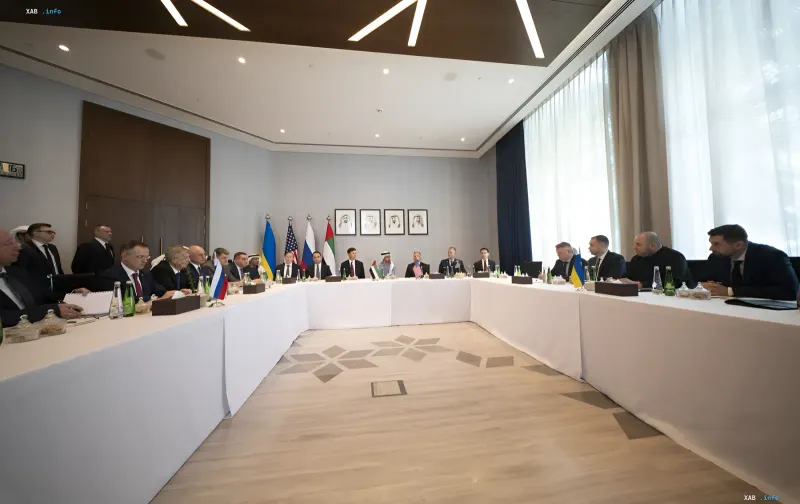
The second day of trilateral talks between delegations from Ukraine, the USA, and Russia has concluded in Abu Dhabi, marking the first meeting in this format since February 2026. The first day of the meeting lasted about 4.5 hours, and the second lasted two. The Ukrainian delegation was led by Rustem Umerov, the Russian side by presidential aide Vladimir Medinsky, and the American side was represented by presidential envoys Steve Witkoff and Jared Kushner. Following the two-day summit, the parties reached a key agreement: to prepare a large-scale prisoner-of-war exchange, which, according to President Volodymyr Zelensky, could take place in a "1,000 for 1,000" or "1,500 for 1,500" format.
"Tough" Negotiations and Moscow's Red Lines
A member of the Ukrainian negotiating team, head of the "Servant of the People" faction David Arakhamia, described the two-day consultations as "tough," explaining this by the strict directives given to the Russian delegation, which, according to him, left no room for compromise. According to sources from RBC-Ukraine, the Russian side refused to discuss a ceasefire, territorial issues, energy, or security in the Black Sea, insisting on a return to their security demands from December 2021. At that time, Russia specifically demanded an end to NATO expansion and limits on the military cooperation between the North Atlantic Alliance and Ukraine.
Kremlin's Position: NATO Non-Expansion and "Non-Aggression Pacts"
Kremlin spokesperson Dmitry Peskov stated that "verbal assurances" regarding NATO's non-expansion to the east are "not enough" for Russia and hinted that this must be put on paper. Russian Foreign Ministry representative Alexey Drobinin reported that Russia is proposing the conclusion of so-called "non-aggression pacts" with individual NATO countries. These statements set the framework in which Moscow is willing to discuss security guarantees, but do not show readiness for compromise on other settlement topics.
US Envoys' Visit to Moscow and Dublin
After Abu Dhabi, Witkoff and Kushner traveled to Moscow, where they met with Vladimir Putin for about three hours on November 12; the meeting was also attended by Medinsky, Kremlin representative Kirill Dmitriev, and presidential aide Yuri Ushakov. Putin declared his readiness to organize a humanitarian mission in Kostyantynivka, following the example of Oleshky, and repeated claims about the Russian military's "control" over the city. He also emphasized that the presence of foreign troops in Ukraine after peace is reached is unacceptable to Moscow, and that if they are stationed there, they will become a "legitimate target" for the Russian army, after which the war will resume. Furthermore, Putin spoke out against the creation of "gray zones" between Ukraine and Russia, stating that the only line of demarcation must be the state border.
Results for Kyiv and the Role of Europe
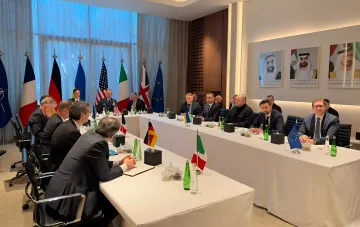
At the meeting in the Kremlin, Witkoff called the future prisoner exchange progress in the settlement process and stated that he would pass information about his contacts with Putin to Zelensky. Kushner stated that the US has begun discussing the security architecture on the continent with European partners. Late on November 12, the American envoys met with Volodymyr Zelensky in Dublin, who confirmed that the main result was the agreement on the largest prisoner-of-war exchange since the start of the full-scale war, as well as a more active involvement of Europe and preparations for new multilateral meetings. The question of European partner participation became one of the key points: in Abu Dhabi, parallel to the trilateral meeting, separate consultations were held between Ukraine, the US, and European partners—representatives of NATO, the European Commission, the UK, Germany, France, and Italy, in which the Russian delegation did not participate. Ukraine and European partners insist on further European participation in direct meetings involving the Russian Federation, with a new round of negotiations expected as early as next week.