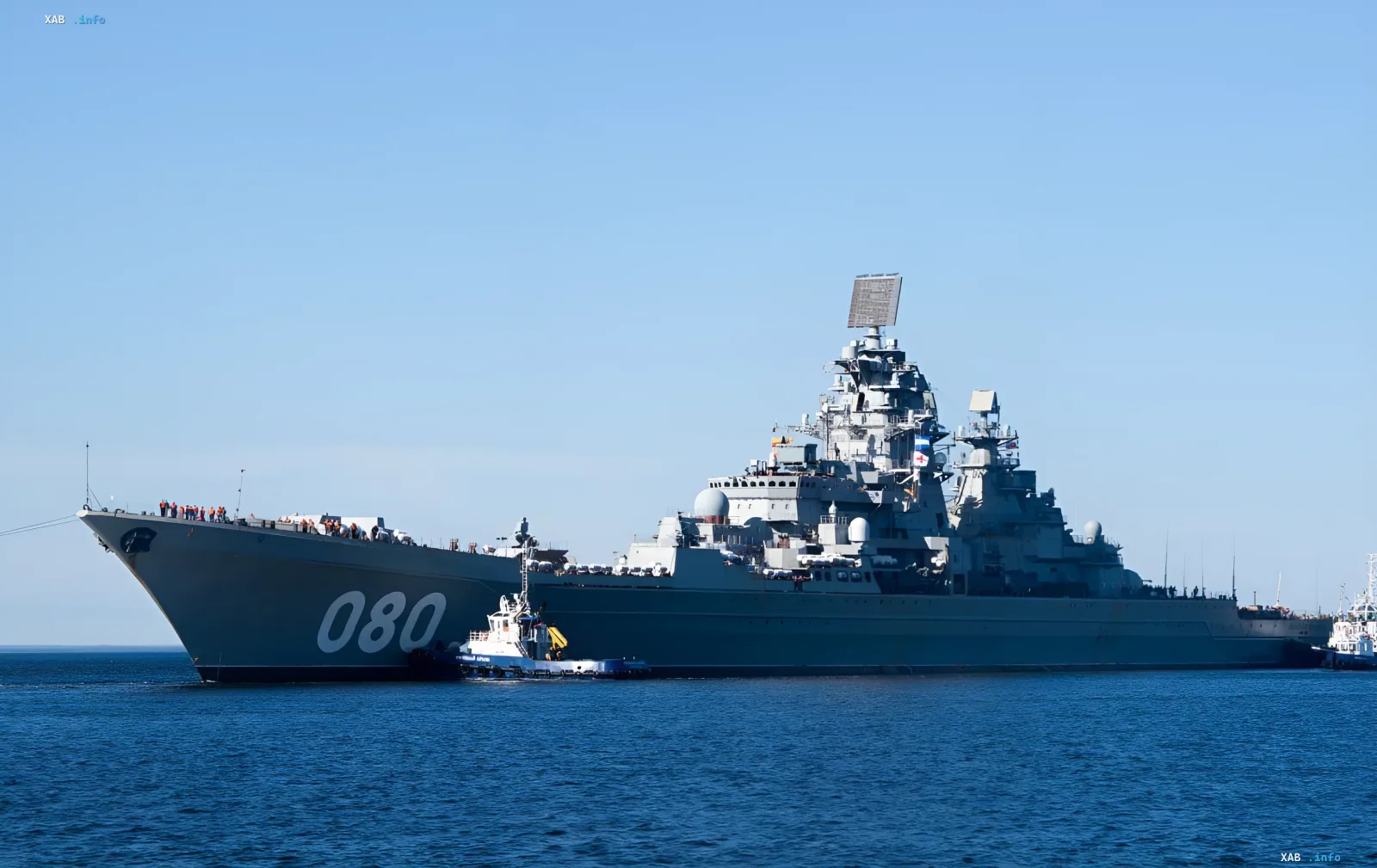
The Russian Navy is preparing to take into its ranks one of the fleet's largest warships — the nuclear-powered missile cruiser 'Admiral Nakhimov' (hull number 080). According to the publication 'Novye Izvestia,' as cited by RBC-Ukraine, the ship is to join the fleet by the end of 2026 after completing a series of sea trials. In photographs taken during the sea trials, the cruiser is accompanied by a tugboat, and crew members in life jackets can be seen on deck — a typical scene of the final stage of factory and state trials. The return of the ship, which has been in the dock at the Baltic Shipyard since the late 1990s, will be one of the most notable events in Russian naval construction in the past decade.
New Armament: From 'Granit' to 'Zircon'
The key element of the modernization was the complete replacement of the missile complex. Initially, Project 1144 cruisers carried 20 P-700 'Granit' anti-ship missiles, launched from inclined launchers. During the refit, 'Admiral Nakhimov' was fitted with vertical launch systems compatible with the 'Kalibr' cruise missile family, the supersonic 'Oniks,' and, according to Russian sources, the hypersonic 'Zircon.' In total, the ship is equipped with 176 vertical launch cells: 80 for strike missiles and 96 for the air-defense missiles of the S-400 air defense system. Thus, after modernization, the cruiser effectively combines the functions of a carrier of long-range strike weapons and an air-defense platform, making it a multi-role vessel. In addition, a 130-mm AK-192M gun mount and new radar systems have been installed, and the helicopter deck is designed to operate Ka-27 and Ka-31 helicopters — the latter equipped with a radar station that extends the detection range for air and surface targets.
The Ship's History and Nearly Three Decades in the Dock
According to Russian sources, 'Admiral Nakhimov' is the third ship of Project 1144 'Orlan.' The ship was laid down at the Baltic Shipyard in Leningrad in 1983, launched in 1986, and commissioned into the Soviet Navy in 1988. Cruisers of this project are large nuclear-powered missile ships designed for engaging major surface targets, air and anti-submarine defense, and performing command functions. The ship is listed in the Northern Fleet, but a significant part of its combat history has been spent in repair. Modernization work formally began in 1999, while the active phase of the refit took place in 2013. The completion of the work was initially planned for 2018, but the deadlines were repeatedly postponed, and by 2026 the ship has spent approximately 27 years in the dock since the start of the work.
Strategic Significance and the Arctic Vector
Upon returning to service, 'Admiral Nakhimov' could become one of the flagship ships of the Russian fleet. According to analysts, Moscow places particular importance on its deployment in the Arctic, where competition over sea routes and resources is growing. In theory, the modernized cruiser is capable of striking Ukrainian territory using 'Kalibr' and 'Oniks' cruise missiles, but to do so it would need to close to the effective range of its missile armament, which, given the opponent's advanced air-defense systems, carries significant risks. Nevertheless, the very fact of a ship with 176 vertical launch cells and a nuclear power plant, providing virtually unlimited range, joining the fleet substantially changes the balance of power in the Baltic and Barents Seas.
Contradictory Data
Open sources show discrepancies in assessing the duration of the ship's repair. The RBC-Ukraine headline refers to '27 years of repair,' which arithmetically corresponds to the period from 1999 to 2026. Meanwhile, UNN and UNIAN use the formulation 'nearly 30 years of repair' in their headlines, which may be due to taking into account the period of the ship's actual unavailability for combat use that preceded the formal start of modernization work. In addition, the original text describes 'Admiral Nakhimov' as the 'third ship of Project 1144,' whereas by the generally accepted chronology of the project's keel-layings (Kirov — 1976, Frunze — 1978, Leningrad — 1980, Admiral Nakhimov — 1983) it is the fourth. The difference in numbering may be related to the fact that some sources count only the serial ships, while others include the lead ship. The exact number of launch cells (176) and their distribution (80+96) are cited exclusively according to Russian sources and have not been confirmed by independent intelligence analysis.
Context: Intensification of Russian Naval Presence
The return of 'Admiral Nakhimov' to service is taking place against the backdrop of a noticeable intensification of Russian naval presence in Europe. In June 2026, an unusual Russian convoy was recorded off the coast of Denmark, which included the yacht Graceful, linked to Vladimir Putin. In January of the same year, the British Royal Navy expelled a Russian ship from the Bristol Channel after it had been moored near critical undersea telecommunications cables. These episodes, along with the return to service of the fleet's largest nuclear cruiser, point to Moscow's consistent strategy of strengthening its naval presence and demonstrating its military-technical potential in Europe's coastal waters.