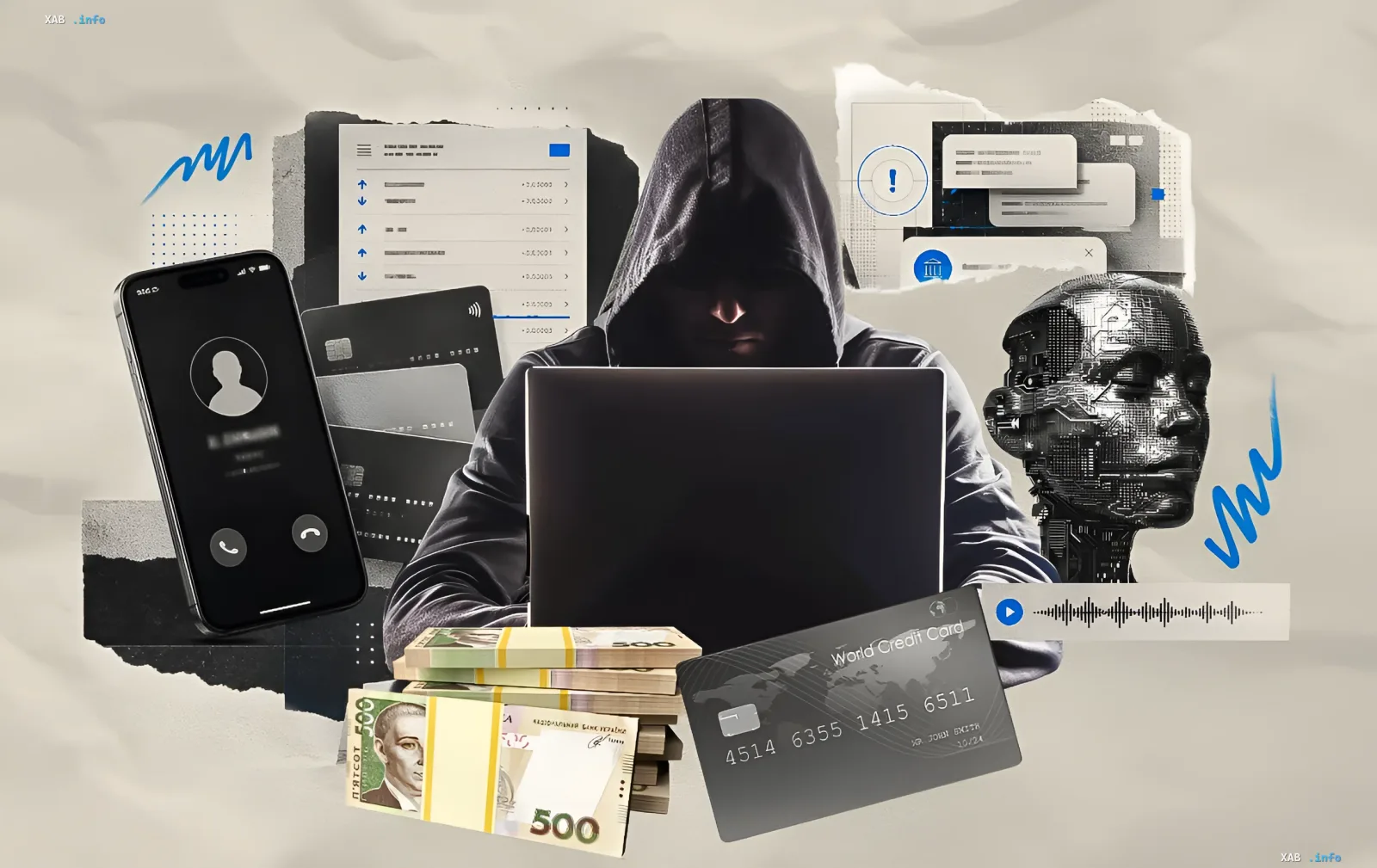
In 2026, financial fraud in Ukraine has reached a new technological level: criminals are actively using artificial intelligence tools to clone voices, create deepfakes, and automate deception. A familiar voice in a messenger voice message, a convincing "bank employee" on the other end of the line, or a video of a well-known person supposedly advising you to invest may all turn out to be part of a single scheme tailored to a specific individual.
A Loved One's Voice as a Tool of Deception
This scenario is no longer fictional. Natalia Figol, head of the fraud management department at PrivatBank, notes that the bank is receiving reports from clients who received AI-generated voice messages in messengers from friends, relatives, or colleagues asking to lend or transfer funds. According to her, the scheme begins with collecting material to reproduce the voice: criminals hack an account, process publicly available audio and video recordings with neural networks, and create a message that almost identically reproduces the owner's timbre, intonation, and manner of speech. The fraudsters then gain access to the account and send such messages to contacts, creating artificial urgency.
Deepfakes and Bypassing Biometrics
PrivatBank has also recorded unsuccessful attempts to bypass biometric checks using AI-generated 3D models and deepfake faces, as well as passing video verification with fake documents created with AI. According to bank representatives, the key change is that familiar fraud techniques have gained new technological tools: audio and video content is produced faster, voices are cloned, correspondence is automated, chatbots imitating support services are configured, and phishing messages and websites are generated on a mass scale.
The Target Is Human Behavior
It is important to understand: AI itself does not gain access to money. In most schemes, criminals need to convince the victim to perform an action on their own — click a link, enter card details or passwords, install a third-party app, or transfer funds to a specified account. The Cyber Police emphasize that the target of the attackers is not the banking app or service, but human behavior, for which social engineering techniques are used: artificial urgency, psychological pressure, and persuasion to disclose confidential information. AI has not replaced social engineering — it has given fraudsters tools to create deception faster and tailor it more precisely to the victim.
The Numbers: Fewer Transactions, but Higher Losses
According to data cited by RBC-Ukraine, referencing the NBU, the number of illegal transactions with payment cards in 2025 decreased by 5% — to 256 thousand, while the amount of losses grew by 24% and reached 1.4 billion hryvnia. The average amount of a single fraudulent transaction increased by 30% — to 5,536 hryvnia. This means that attacks are becoming less frequent, but more "targeted" and costlier for victims.
Contradictory Data
There are two notable inconsistencies here. The first is in the assessment of the scale of voice cloning: the Cyber Police note that they record isolated cases of voice cloning technology being used in fraudulent activities, but emphasize that these do not yet have a mass character, whereas PrivatBank reports regular client inquiries with similar messages. The second is in the dynamics of the statistics: with a 5% decrease in the number of transactions, losses and the average ticket grew by 24% and 30% respectively, which may indicate either a change in attackers' tactics or differences in counting methodology. Both versions are presented openly, and a final assessment of the scale requires additional data.
How to Recognize the Danger
Recognizing such deception is helped less by the characteristics of the voice itself than by context and behavior: atypical urgency, a request not to call back or verify, pressure on emotions, and a demand to transfer money to a "safe" account or install a third-party app. Banks and law enforcement agencies recommend that in case of any suspicious request to transfer funds, you should break off the correspondence and contact the loved one by a known phone number, as well as not click on links or install apps on the instructions of "bank employees."