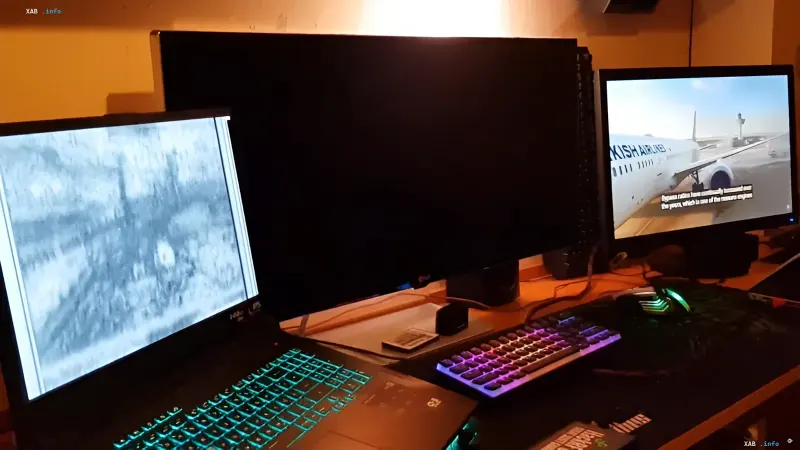
A standard HDMI cable connecting a laptop or computer to a monitor can become a source of confidential information leakage: through the electromagnetic field it radiates during signal transmission, an attacker can almost completely reconstruct the image displayed on the screen. This capability is demonstrated by the TempestSDR system, which intercepts the signal 'leaking' from the HDMI connection and turns it back into a picture. In the demonstration configuration shown in the article, a laptop on the left and a turned-off central monitor sit next to a screen displaying the image recovered from a neighboring display via leaked radio signals.
How Interception Works: From Antenna to Image
The working principle of TempestSDR relies on the fact that any wired interface creates an electromagnetic field around itself during data transmission, the parameters of which can be read by an external receiver. An antenna captures this leak, a HackRF-based radio receiver captures the signal, and software reconstructs the image from it. The quality of the resulting picture is initially low and heavily depends on cable shielding quality, distance to the source, and interference levels, but even a blurry image remains recognizable enough for the screen's contents to 'show through'.
Where the DeepTempest Neural Network Comes In
A significant step forward was made by Federico Larroca from the University of the Republic in Montevideo, Uruguay, who developed the DeepTempest neural network. It is designed to enhance recovered images and text: the network makes text readable and the picture sharper, reducing the error rate by more than 60% compared to the baseline method. When capturing text, the system reconstructs the content with an error rate of about 30% of characters, which is 60% lower than the most advanced existing attack methods. However, as emphasized in the material, the final picture remains blurry—AI improves readability but does not turn the leak into a perfect copy of the screen.
Practical Limitations: Distance is Key
An important limitation of the technology is distance. For a successful interception, the attacker must be close to the cable—essentially close enough to actually be able to see the screen whose signal they are trying to read. Being in a van across the street, for example, would make 'reading' anything extremely difficult even if the cable has very poor shielding. Thus, the technology poses a real threat in close-access scenarios, but is not a universal long-distance surveillance tool.
Protection and the Origin of the Code Name 'Tempest'
The authors call the use of high-quality cables with electromagnetic shielding the most effective way to protect against such attacks. Such shielding is necessary not only to ensure high audio and video quality, but also to reduce signal leakage. The name 'Tempest' itself in such systems is no accident: it is the code name adopted by the US NSA to designate surveillance through electromagnetic leaks, as well as countermeasures against it. The combination of these factors—proximity, shielding, and interference—determines whether it will be possible in a specific case to reconstruct screen contents from the 'wireless trace' of a wired connection.