
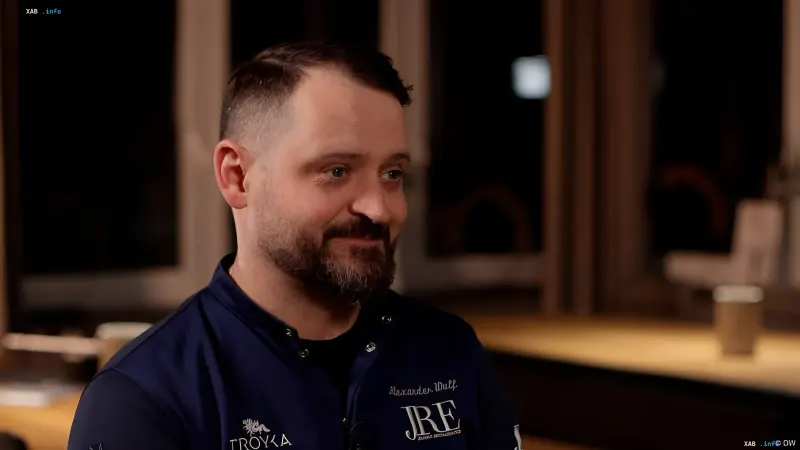
In the town of Erkelenz, located about 30 kilometers from Düsseldorf, the capital of North Rhine-Westphalia, the restaurant Troyka stands on the edge of a field. At first glance, this place does not look like a candidate for a culinary "Oscar," yet it is here, in a one-Michelin-starred establishment, that chef Alexander Wulf serves guests what he calls "Russian cuisine" every day. As of 2026, there are over 300 restaurants in Germany featured in the Michelin Guide, with the vast majority holding one star. Germany ranks among the world leaders in terms of the density of Michelin-starred establishments per capita. DW visited Troyka on a special day for the chef—his son's birthday—when Alexander had to simultaneously prepare a Michelin-standard gourmet menu and grill shashlik for a group of 18 teenagers.
The Road from Siberian Cuisine to a Michelin Star
Alexander Wulf was born in Siberia. Before moving to Germany, the family lived in Kazakhstan. When he was nine, they moved to the FRG. Alexander is from a family of Russian Germans (the term Russlanddeutsche is used for ethnic Germans who arrived in Germany from the USSR). In an interview with DW, he admits he "would really like to have his own land": "Where is my land—Russian, German? I think I will miss that all my life." At the same time, he calls Germany his home: "The children were born here. I am very happy that they can live here and have a home." His first steps in cooking were inconspicuous: at 12, Alexander and his brother washed dishes in a nursing home. The head chef there noticed the boy rearranging the garnishes on plates and said: "You should spend less time washing dishes and more time in the kitchen." Since then, according to Wulf, the kitchen has always been his "most beautiful place"—"those smells, the clatter of pots, the aroma of meat and onions."
Resurrecting Russian Cuisine: A Chance Encounter in Belgium
Alexander's path led through Austria and Belgium before he returned to Germany. A key moment in shaping his culinary identity occurred in 2014 in Belgium, where he was working at a castle restaurant. Doctors from Moscow and St. Petersburg came for dinner. Alexander served them salo and smoked fish—homemade style, with tomatoes. "They sat down, ate, had 100 grams, of course, and said: 'Why are you doing French things when you cook Russian things much better?'" the chef recalls. That was when it hit him: he grew up with this cuisine, and the French technique he had been using could and should be adapted for a "Russian look." Not everyone liked the idea of focusing on Russian cuisine, but Alexander was sure it would work.
Troyka: 30 People, One Star, and 80 Percent Germans Among Guests
The Troyka restaurant in Erkelenz, a town of fewer than 50,000 residents, opened in 2021. The Michelin inspector, as is custom, arrived incognito. The first dish Alexander prepared for them was the "Siberian Garden"—vegetables marinated according to his grandmother's recipe and served on a plate. "If I had known what I got the star for, I probably would have worked for a second one," the chef jokes. He isn't dreaming of a second star yet: there is barely enough time for family and friends, and keeping a star is harder than winning one. "We have 30 people working in the restaurant; keeping them motivated every day is very difficult," Wulf admits. Under the umbrella of "Russian cuisine," Troyka serves "the most beautiful, tastiest dishes" from post-Soviet countries. The restaurant team is international: the staff includes people from Germany, Slovenia, Taiwan, Russia, Ukraine, and Moldova. According to the chef, about 80 percent of the guests are German.
"You Just Have to Understand That Everything Is Possible"
Today, Alexander Wulf is a media personality and a frequent guest on popular entertainment shows. DW filmed him in the kitchen on a day when, alongside Michelin service, the chef was grilling shashlik for teenagers. He willingly shared his marinade recipe for the shashlik with journalists. In the Bundestag, he cooked for "Anna Pavlova"—a character that has become part of the public narrative surrounding the restaurant. Like a mantra, while cooking in his restaurant's kitchen, Alexander repeats: "You just have to understand that everything is possible." In Russia, restaurants first received Michelin stars in 2021—there were nine at the time. After the start of Russia's full-scale war in Ukraine, the Michelin Guide completely froze its operations in Russia, and currently, there are no official restaurants with Michelin stars in the country. For Wulf, who grew up between three countries and found himself on the edge of a field in Erkelenz, this story is not just a career. It is proof that "everything is possible" if you stop washing dishes and start standing in the kitchen.


