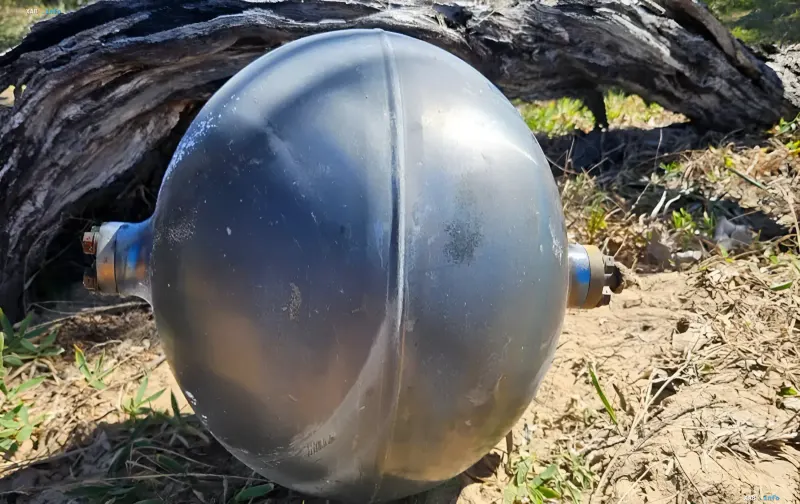
A real detective story has unfolded on the coast of Queensland, Australia. Locals discovered six massive titanium spheres of unknown origin on the beach. The unusual find instantly caused a stir in the small community of just over a thousand people, sparking a wave of the boldest theories.
Panic and hazmat suits
Visually, the find was indeed frightening: smooth, dark metal spheres lay on the sand, as if rolled out of a science fiction movie script. The situation seemed so serious that fire and rescue teams in full chemical protection suits were urgently dispatched to the scene.
Security services immediately declared a 50-meter exclusion zone around the objects. Five spheres were loaded into special protective containers for transport. The sixth sphere, according to experts, was deemed safe to move without enhanced sealing.
The police officially assured the population that the objects do not emit radiation and do not pose a direct threat to life. However, firefighters warned locals: if the sea washes up new debris in the coming days, they should not be touched.
Business on the "alien" news hook
While rescuers isolated the area, local businesses instantly assessed the prospects. Entrepreneurs decided to maximize profits from the hype surrounding the "alien" incident, turning fear and curiosity into revenue.
Rumors of an extraterrestrial invasion persisted until the Australian Space Agency issued an official clarification. It turned out that the found objects have an exclusively terrestrial origin.
"Space spheres": what actually fell?
Specialists determined that the mysterious spheres are high-pressure fuel tanks used in the construction of launch vehicles. In the professional community, such reservoirs are officially called "space spheres".
The characteristics of the finds and the place of their discovery fully match the atmospheric entry trajectory of the body of a foreign rocket that recently deorbited. Experts in space archaeology from Flinders University added an important technical nuance: the absence of visible burn marks on the titanium indicates that the tanks separated from the rocket at a relatively low altitude. This is what allowed them to survive the fall.
History of falls: from New Zealand to the USA
Although the fall of spacecraft debris on land or in coastal areas is a rare phenomenon, Oceania has already encountered similar incidents. The most famous case occurred in 1972 in New Zealand. At that time, Soviet satellite spheres from the "Kosmos-482" mission fell on farmland.
At that time, frightened local law enforcement officers, fearing radiation, even locked one of the metal spheres in a prison cell overnight until the nature of the find was determined.
Specialists reassure: the chances of being injured by a falling spacecraft are negligible, as most of the planet is covered by oceans and uninhabited territories. Throughout human history, only one case has been recorded where debris caused harm to a person. This happened in 1997 in the USA, when a light piece of a Delta II rocket grazed a woman's shoulder, causing no serious injury.