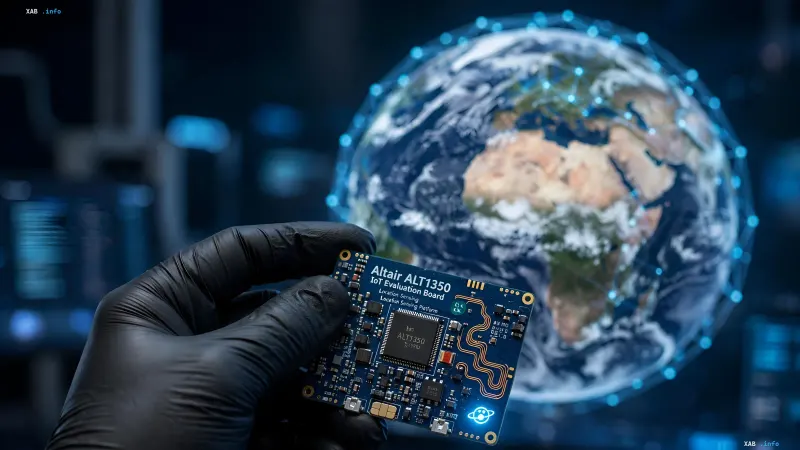
Altair Semiconductor has announced the integration of the Iridium NTN Direct satellite service into its ALT1350 and ALT1550 chipset platforms. According to the manufacturer, terrestrial cellular connectivity of the LTE-M and NB-IoT standards and the global Iridium satellite channel have been combined on a single die for the first time. This solution eliminates the need for IoT device manufacturers to install a separate satellite modem, simplifying the design, reducing costs, and lowering the power consumption of the final product.
Two chipsets for different tasks
The ultra-low-power ALT1350 platform is targeted at a wide range of tasks: asset tracking, logistics, smart resource metering, utilities, agriculture, transport telematics, industrial monitoring, and remote infrastructure. The higher-performance ALT1550 supports the 5G eRedCAP standard and is designed for a new generation of AI-enabled devices and wearable gadgets that require stable connectivity anywhere on the planet, including areas not covered by terrestrial networks.
Technological foundation of Iridium NTN Direct
The Iridium NTN Direct satellite service relies on the fully deployed Iridium low-Earth orbit (LEO) satellite constellation and globally coordinated L-band spectrum. The service supports NB-IoT and Device-to-Device (D2D) direct connectivity standards for 3GPP-compliant chipsets, ensuring continuity with the existing cellular technology ecosystem and simplifying manufacturer migration to hybrid solutions.
Industry evaluation and ecosystem prospects
“Integrating Iridium NTN Direct into Altair's chipsets will enable solutions that require reliable, low-power connectivity beyond terrestrial networks,” said Tim Last, Senior Vice President at Iridium. Altair is joining a growing ecosystem of partners bringing the Iridium NTN Direct service to market. Combining two communication channels on a single die paves the way for the mass production of compact IoT terminals capable of operating in environments where traditional cellular infrastructure is unavailable—from polar regions to deep-sea and aviation use cases.