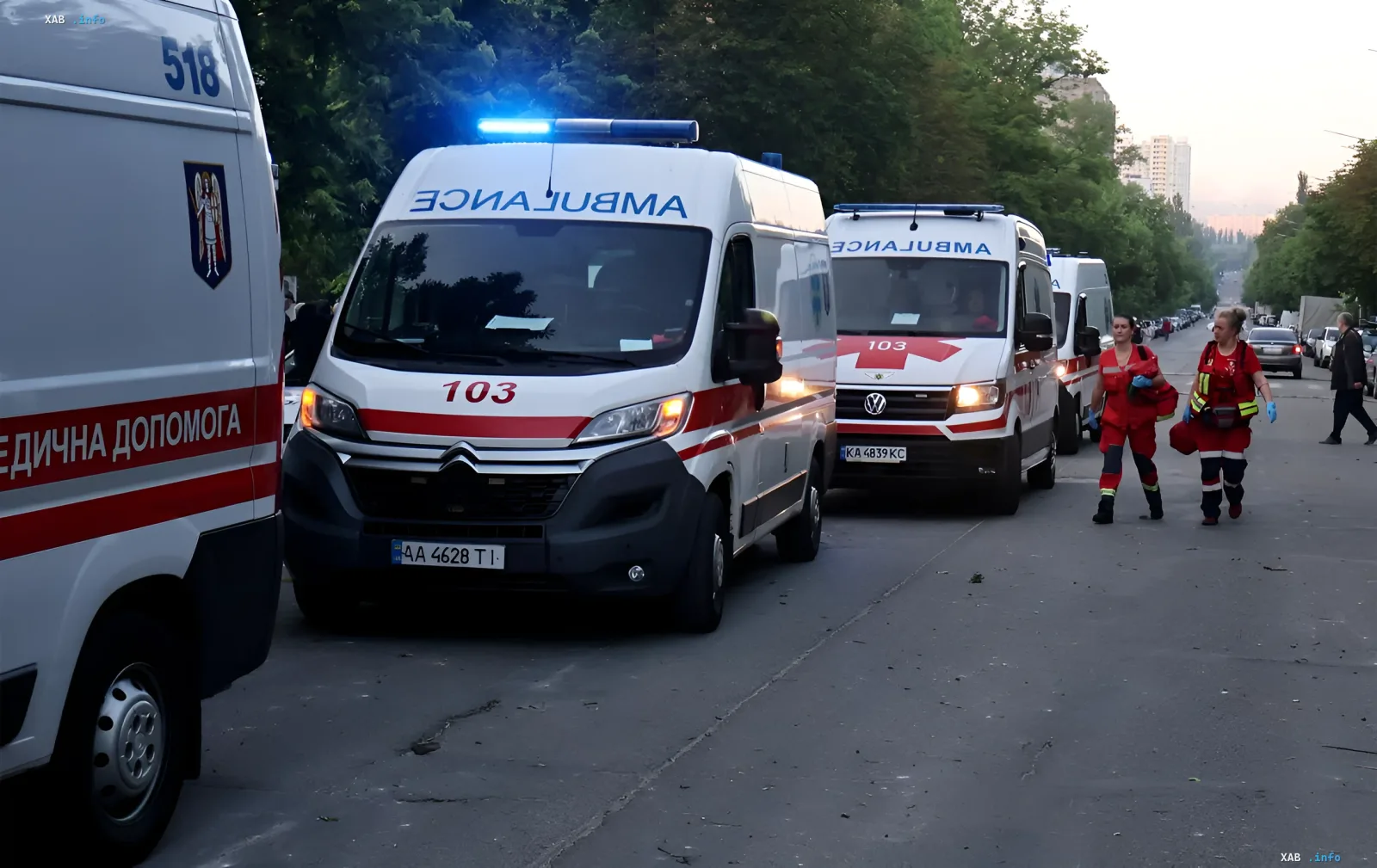
A controversy has erupted in Kyiv regarding the performance of the emergency medical services. The trigger for the discussion was an incident involving a wounded resident of the capital who claimed he could not reach an ambulance in a timely manner during a Russian attack. In response, the Kyiv City State Administration (KCCA) and the Department of Health published detailed statistics on the work of medical personnel and clarified the rules of their actions under combat conditions.
The situation with the injured: the patient's version and the authorities' response
The incident that triggered the official reaction involved Kyiv resident Yuri Tereshchuk. According to him, after being wounded during a strike, he tried to call for help twice. The first time, no one answered, and on the second call, he was allegedly told that a team could only be dispatched after the end of the air raid alert. Nevertheless, both state and private medical personnel arrived at the injured man, provided assistance, and hospitalized him.
The Department of Health refuted the claim that assistance was not provided in a timely manner. The department emphasized that the capital's emergency medical system has been operating continuously since the beginning of the full-scale invasion. The service reminded that during active shelling, medical personnel are forced to take into account the threat to their own lives. The decision to deploy is made by the team leader, who assesses the actual situation on the ground, but the system itself does not stop working.
Scale of work: figures and facts
The authorities provided data demonstrating the colossal volume of work of the capital's rescuers. Every day in Kyiv, 130 teams of the Center for Emergency Medical Care and Disaster Medicine are on duty. The statistics for the period from February 24, 2022, to June 17, 2026, are as follows:
- A total of 26,569 trips were made during the war.
- Assistance was provided to 25,853 wounded people.
- In just the first month of June, teams worked at 102 locations, helping 102 victims.
- During the mass attack on June 3, medical personnel worked at 47 locations, and 78 teams were involved in the response. Assistance was received by 72 people, including three children.
- On June 15, 71 teams worked at 55 locations, providing assistance to 30 people.
Evacuation of wounded military personnel
A separate and critically important area remains the work with wounded soldiers. Since the beginning of the full-scale war, 1,114 teams have carried out targeted evacuation of 1,320 military personnel to hospitals in other regions of Ukraine and abroad. In addition, more than 21,000 teams ensured the transportation of more than 22,000 wounded between trains and medical institutions in Kyiv and the region.
Personnel decisions and accountability
On the evening of June 17, the Department of Health announced serious personnel changes. As a result of the inspection of the Kyiv City Clinical Emergency Medical Hospital, a decision was made to dismiss the director of the institution, Viktor Dorosh. His contract will be terminated early on June 18, 2026.
During the inspection, numerous violations, failure to meet contract conditions, and improper performance of official duties were identified. The department stated that the decision was made in accordance with the legislation based on the conclusions of the relevant commission. All recorded violations received the appropriate managerial assessment.
Funding and call for accountability
In 2026, the state increased funding for emergency medical care by almost 2 billion hryvnias. These funds are directed towards the purchase of medicines, fuel, staffing, and improving the work of the service, especially in rural areas. The National Health Service has already introduced special support measures for rural teams.
To conclude, the Department of Health called on the media, bloggers, and social media users to responsibly approach the dissemination of information. The department warned that unfounded accusations against medical personnel could undermine trust in the services on which people's lives depend in critical moments.


