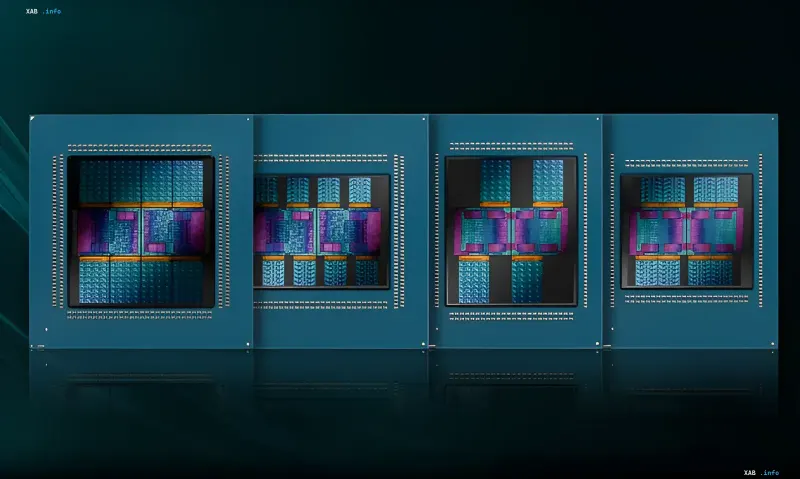
AMD has officially unveiled pricing and expanded technical specifications for its new lineup of EPYC Venice 9006 server processors. While the presentation of this chip generation took place back in July of this year, the full price lists and specifications have only now become available. In total, over 30 different processor models are available for order, designed for single-socket and dual-socket server systems.
SP7 Lineup: Maximum Performance and AI Workloads
The high-end SP7 family includes nine advanced EPYC Venice 9006 configurations offering from 64 to 256 computing cores with multithreading support. L3 cache size across these models ranges from 384 to 1024 MB, with a TDP rating from 300 to 600 W. Base frequency reaches up to 3.75 GHz with boost clocks hitting 5 GHz depending on the modification. These new chips support 16-channel RDIMM DDR5-8000 and high-speed MRDIMM DDR5-12800 memory. Prices for orders in batches of 1,000 units range from $8,008 to $14,904 per unit.
SP8 Series: Flexibility and Accessibility for Mainstream Tasks
For a broader range of applications, the company prepared the SP8 family, featuring 22 processor models. These chips feature core counts ranging from 8 to 128, L3 cache sizes from 48 to 512 MB, and TDP levels spanning from 130 to 400 W. Maximum clock speeds also reach up to 5 GHz with base speeds up to 3.8 GHz. The memory subsystem utilizes an 8-channel design supporting RDIMM and MRDIMM modules. The pricing spectrum for the SP8 platform is significantly broader and more affordable, starting at $700 for entry-level versions and scaling up to $11,679 for large batch orders.
Refined Specifications and Market Outlook
During the official rollout, the manufacturer also updated certain technical parameters of the lineup. Specifically, the previously announced support for up to 128 PCIe 6.0 lanes in a single-socket configuration applies exclusively to SP8 variants, while flagship SP7 processors are limited to 96 lanes. All products are manufactured using advanced 2nm process technology. AMD emphasizes that the new offerings are optimized not only for traditional server workloads but also for artificial intelligence tasks, including agentic AI, delivering industry-leading energy efficiency and total cost of ownership (TCO).