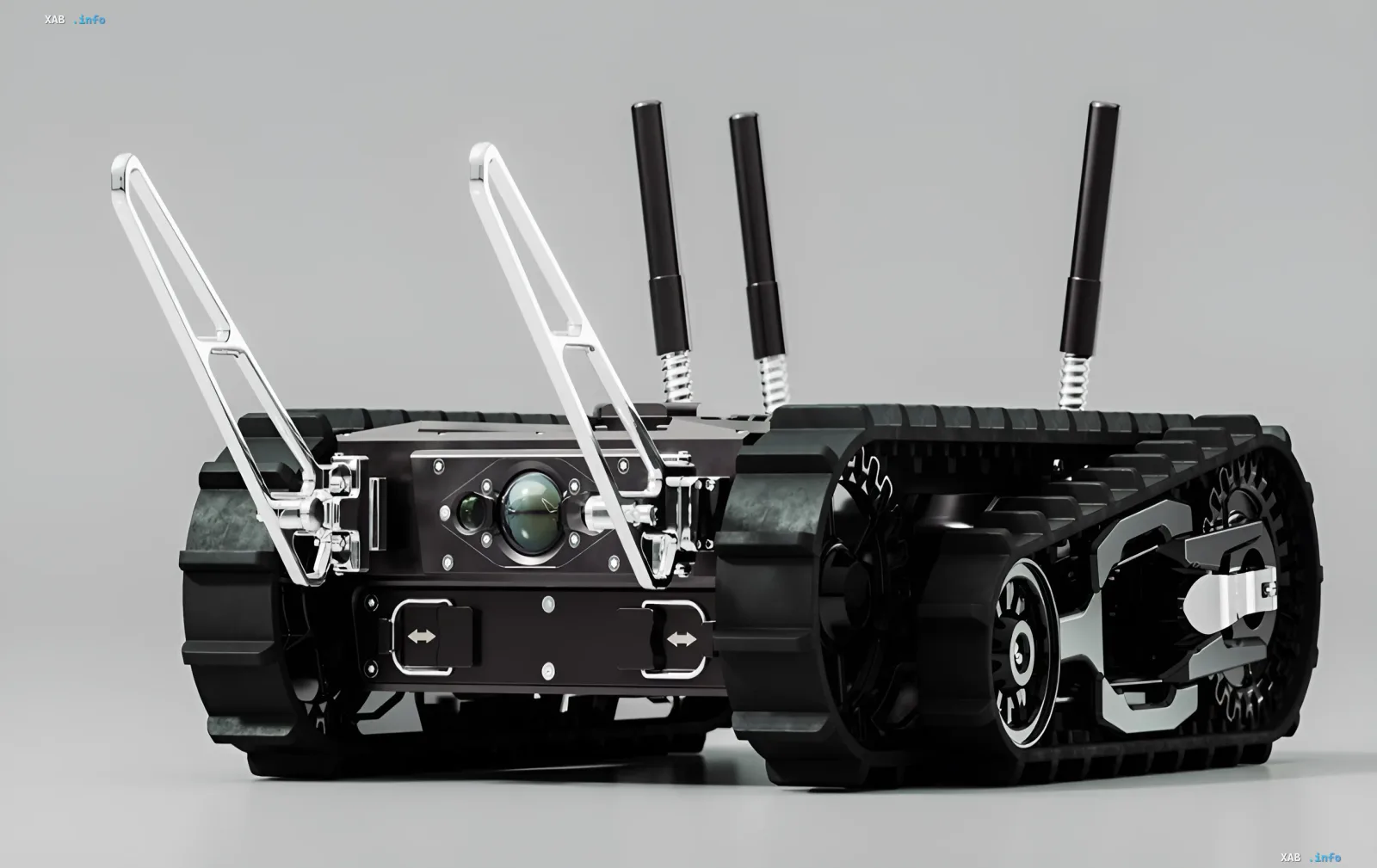
At the Eurosatory 2026 international defense exhibition in Paris, the American company AeroVironment, through its subsidiary Telerob, officially presented a new class of ground robotics — the ultra-light unmanned robot TOM 50 RE. The novelty aims to solve the critical problem of mobility in modern urban warfare and special forces operations.
Tank in a backpack: a revolution in mobility
The main trump card of the new development is its compactness. The robot weighs no more than 10 kilograms, allowing a single soldier or special forces operator to carry it in a standard backpack. This radically changes the logistics of reconnaissance operations: the equipment no longer needs to be transported by trucks or unloaded from armored personnel carriers; it moves in step with the infantry.
The device is built on a tracked chassis, ensuring cross-country capability on difficult terrain. To overcome vertical obstacles and stairs, the robot is equipped with a special "fin" system, allowing it to climb where ordinary equipment would get stuck.
Navigation where there is no GPS
One of the key problems when working in buildings, bunkers, and dense urban areas is the lack of satellite navigation signals. The developers of the TOM 50 RE solved this problem by implementing Simultaneous Localization and Mapping (SLAM) technology.
Thanks to this algorithm, the robot is capable of building detailed digital maps of rooms in real-time, even if the GPS signal is completely blocked. Military personnel can mark important objects on these maps, and the data is instantly transmitted to command for planning further actions.
Eyes and ears of the operator
To ensure full situational awareness, the unmanned vehicle is equipped with four high-resolution cameras with infrared illumination. The system provides a 360-degree view, working effectively both day and night, as well as in conditions of smoke or limited visibility.
An important aspect is the IP-mesh radio communication architecture. It not only guarantees the security of control channels but also allows the robot to function as a mobile repeater. This is critical for soldiers located inside rubble or deep inside buildings where standard communication does not work.
Modularity and combat application
The robot was created taking into account the requests of the ground forces, sappers, and SWAT units. It is capable of operating continuously for up to 5 hours on a single charge and can carry a payload weighing up to 5 kilograms. The modular Mission Module Interface allows for the quick integration of various tools onto the platform: from sensors to mechanisms for neutralizing explosives.
Experts highlight four main scenarios for the use of TOM 50 RE:
- Mobile reconnaissance: rapid assessment of the situation in unknown and dangerous areas without risk to human life.
- Mission support: conducting reconnaissance with automatic creation of terrain maps for squad navigation.
- Explosive ordnance disposal: neutralization of mines and bombs using modular destroyers or dropping demolition charges.
- Operational support: use as a communication repeater or carrier of additional sensors.
The system is controlled via proprietary Halo software on Tomahawk Grip tablets or the Robo Command Control System console. This allows coordinating the robot's actions within a single loop with other unmanned systems. Developers emphasize that modern operators need mobile systems that quickly adapt to tasks and reduce risks for the infantry by providing instant reconnaissance.


