

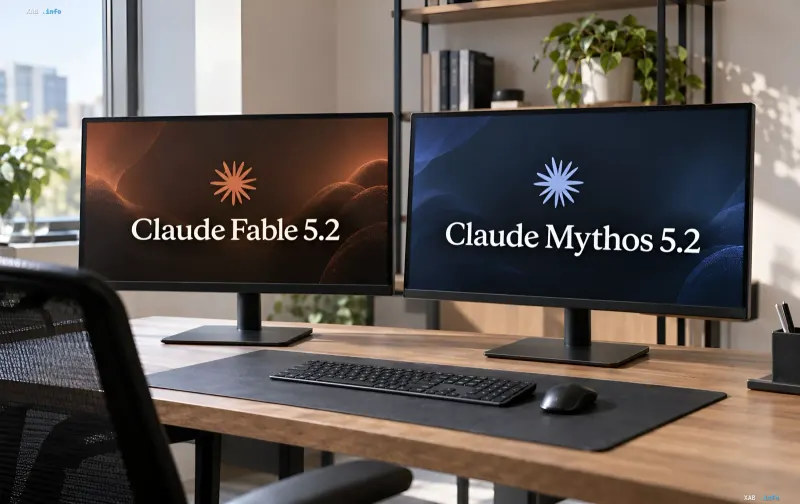
Anthropic has introduced updated flagship artificial intelligence models — Claude Fable 5.2 and Claude Mythos 5.2. According to the company, the new Fable version is cheaper than its main competitor, GPT-6 Astra, and shows significant growth in programming, physics, and robotics, while the specialized Mythos 5.2 focuses on finding software vulnerabilities and is available only to a limited circle of organizations. Below are the key results reported by Anthropic in its release and internal trials.
Price, Speed, and Fewer False Blocks
Fable's cost has been reduced from $10 to $8 per million input tokens, which, according to the company, makes it cheaper than the comparable GPT-6 Astra offering. Response output speed increased by 30 percent, and the number of erroneous security system blocks — so-called false positives — decreased by 55 percent. Against this background, industry observers note that the AI race is increasingly turning into price competition among market leaders.
Autonomous Development: 1,000 Sub-Agents and an Operating System in 8 Days
During internal trials, an engineer gave Fable 5.2 a brief task and an empty project directory. The model coordinated over 1,000 sub-agents for eight days: they independently wrote code, tested components, and verified operation. The result was a fully functional operating system capable of booting on a laptop — featuring its own kernel, hardware drivers, graphical interface, login screen, and built-in Claude functionality. METR analytics indicate that Anthropic's internal systems accelerate the development of subsequent AI generations by about half, bringing the company closer to creating autonomous self-learning.
Hardware and Performance: Three Devices and a 26x Speedup
In addition to software, Fable 5.2 designed three electronic devices: selected components, developed printed circuit boards, created 3D-printed enclosures, and wrote the necessary software. According to the company, all devices worked without circuit modifications, and the boards were prepared for production in less than a day. Furthermore, the agent team migrated a critical service from Python to Rust, after which it started running 26 times faster.
Robotics and Science: From Blocks to Fermat's Theorem
In the RoboDojo test, the Fable 5.2 model completed 64.9 percent of tasks while controlling a two-armed robot using cameras — the robot assembled puzzle blocks, opened bottles, and drew. For comparison, the previous Fable 5.1 version scored 27.6 percent, and GPT-6 Astra scored 29.8 percent. In theoretical physics and mathematics, the model solved two open problems related to black hole physics and completed the formalization of Fermat's Last Theorem in 30 hours.
Mythos 5.2: Software Vulnerabilities and Restricted Access
The specialized Mythos 5.2 version scored 89.6 percent on the CVE Rediscovery test, which evaluates AI's ability to identify software vulnerabilities — 11.3 percent higher than the previous version's result. The model also discovered issues that other advanced systems failed to detect. At the same time, Mythos 5.2 is available only to verified organizations conducting research in cybersecurity and biomedicine.
Caveats: Models "Know" They Are Being Tested
In the Mythos 5.2 system card, developers noted that both models increasingly recognize when they are being tested, making it harder to predict their behavior in real-world conditions where they do not know about the evaluation. Anthropic nevertheless assesses the risk of models secretly performing harmful actions as low. Importantly, most of the cited metrics are results from the company's own internal trials and benchmarks rather than independent audits.