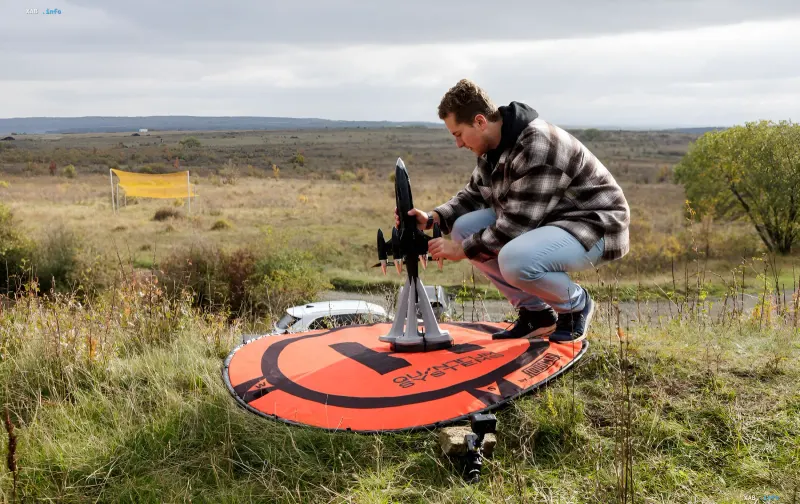
The experimental drone Apex Recordhunter, developed by the German company Quantum Systems, has set a new world speed record for battery-powered aircraft at 727 km/h. The record-breaking flight took place at a military base in Germany, the name of which the company has not disclosed. The craft covered a 100-meter measured distance in one direction and then returned; the official result was the average speed of the two passes. Independent experts on-site verified GPS data against the flight recorder logs, after which the achievement was officially entered into the Drone World Records registry.
Verification and previous benchmarks
The previous confirmed achievement in the battery-powered quadcopter category, recorded by Guinness World Records, was 657.59 km/h, established in December 2025. Thus, the Apex Recordhunter surpassed the former maximum by more than 69 km/h. For a record to be officially recognized, unlike a simple high-speed flight, it requires passing a measured segment in both directions to compensate for wind, which was accomplished during this attempt.
From 777 km/h in drills to official validation
Back in October, during the Forward Edge 26 exercises, the same craft reached 777 km/h in one direction, with a peak speed of 795 km/h recorded over a 27-second flight. However, this result could not be counted as an official record because it did not include a return pass. This is why the company organized a separate record-breaking attempt at a military base where conditions were calibrated to Drone World Records standards. Florian Seibel, co-founder and co-CEO of Quantum Systems, emphasized that "the record is not an end in itself," but rather the company's task is to develop advanced high-speed systems capable of countering new threats. In context, he mentioned Russian "Geran-4" and "Geran-5" jet drones, which reach speeds of up to 600 km/h, requiring a scalable interception solution, according to him.
Apex Recordhunter: a technology testbed, not a weapon
The drone was created by Quantum Systems' experimental N3XT division and is intended for testing high-speed interception technologies. The Apex itself is not classified as an armed system: it is essentially a flying laboratory where engineers test aerodynamic solutions, control systems, and energy characteristics that will later be transferred to next-generation mass-produced interceptor drones. As the company notes, work is already underway on combat systems for the battlefield based on this development.
Maritime drones and cyberattack: broader context
The speed record is not isolated from Quantum Systems' wider product strategy. At the end of the summer, the company introduced its first maritime drones — the surface drone Seavex and underwater drone Subvex, which were demonstrated during NATO exercises in Portugal. Both systems are integrated into the MOSAIC UXS software platform, which already unites the manufacturer's air and ground systems. Concurrently, as previously reported, unknown hackers infiltrated the Munich-based company's corporate networks and placed malware on an update server; as a result, the Bundeswehr temporarily grounded the entire fleet of Quantum Systems equipment. The incident was likely a factor in accelerating the company's move to stricter cybersecurity protocols and the public demonstration of its platforms' operational status, including the record flight of the Apex Recordhunter.