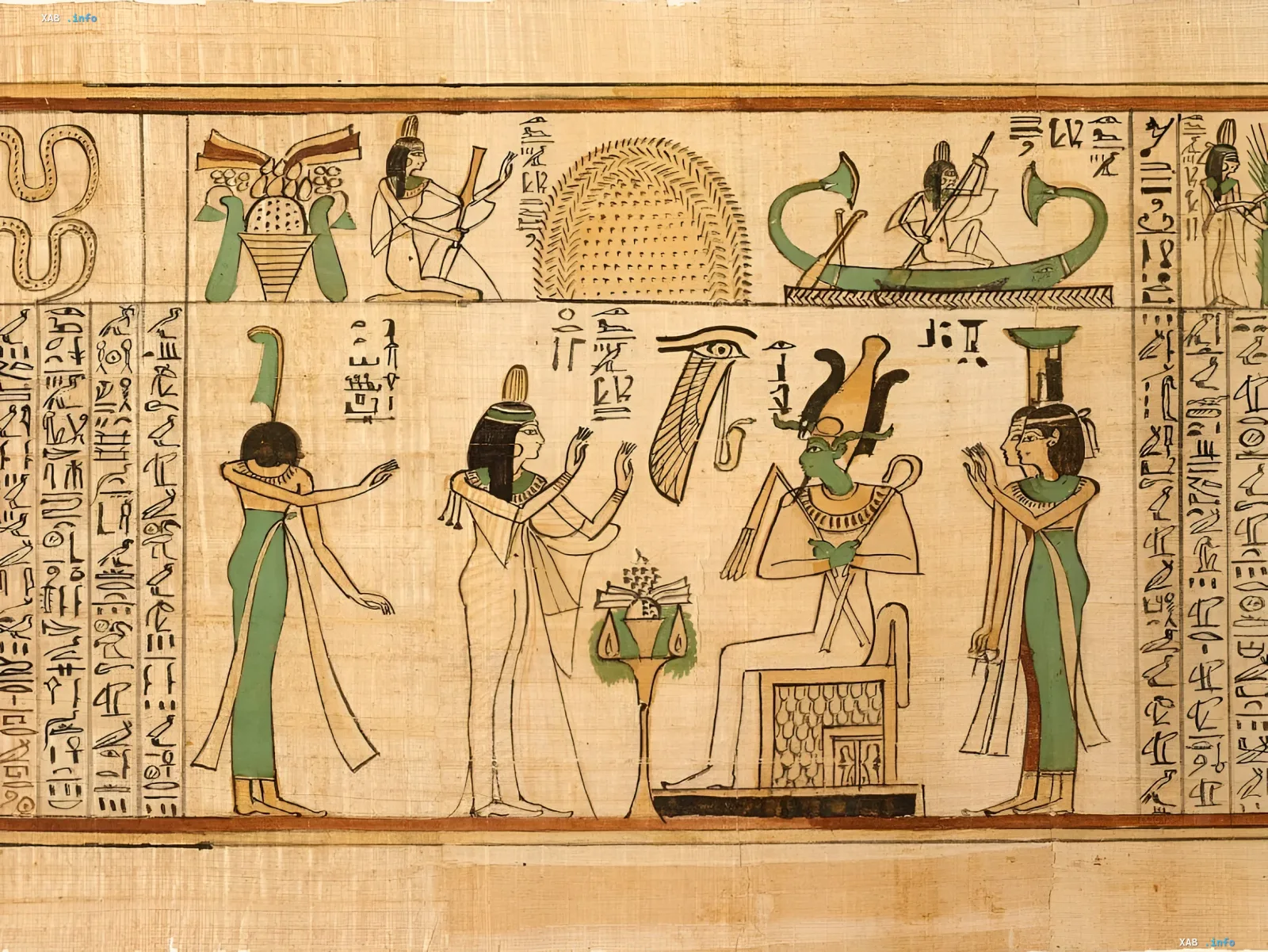
In the Tuna el-Gebel area of Middle Egypt, archaeologists have made a discovery that could rewrite our understanding of ancient burial rites. During excavations at the Al-Guraifa necropolis, a mission from the Supreme Council of Antiquities uncovered a funerary papyrus scroll containing texts from the 'Book of the Dead'. The artifact's uniqueness lies not only in its preservation and length—approximately 13–15 meters—but also in the fact that it was found in situ, meaning in its original burial context.
Relic of the New Kingdom
The discovery dates to the New Kingdom period (c. 1550–1070 BCE), a time of flourishing Egyptian civilization. The fact that the scroll was found directly inside a tomb allows scientists to reconstruct the structure of burial rituals characteristic of the local elite of that time with high precision. Excavations in this region, known as the 15th nome of Upper Egypt, have been ongoing since 2017 and focus on studying the burials of high-ranking officials and priests.
The Secret Al-Guraifa Complex
The discovered manuscript is part of a large funerary complex belonging to representatives of the high clergy and the state apparatus. During the field season, researchers recorded and extracted a number of artifacts attesting to the high status of the tomb owners:
- Anthropomorphic sarcophagi: Stone and wooden coffins with mummified remains were identified. Of particular interest is the painted coffin of Ta-de-Isis, daughter of the High Priest of the god Thoth.
- Funerary inventory: Numerous ushabti figurines were extracted—ritual figures which, according to ancient Egyptian beliefs, were meant to perform labor in the afterlife on behalf of the deceased.
- Amulets and statues: Ritual amulets made of faience and semi-precious stones were found, as well as statues of the deity Ptah-Sokar-Osiris.
- Canopic jars: Sets of alabaster and limestone vessels used for the hermetic storage of internal organs during the mummification process were discovered.
Evolution of religious thought
In modern science, these collections are known as the 'Book of the Dead', however, in antiquity they were called 'The Utterances of Coming Forth by Day'. It is important to understand that this was not a canonical book with an unchanging text. Each scroll was compiled individually, including hymns, spells, and magical formulas. Their content and length varied depending on the social status, financial means of the patron, and local theological traditions of a specific nome.
Studying this new specimen will allow Egyptologists to significantly expand the source base, shedding light on the evolution of paleography and religious thought during the New Kingdom period.
The path to the Grand Egyptian Museum
The found papyrus has already been sent to the laboratories of the Grand Egyptian Museum (GEM) in Giza. There, specialists will conduct comprehensive conservation, carefully unroll the scroll, and begin translating the ancient texts. The official transfer of the artifact to the exhibition halls is scheduled to coincide with the final stages of preparation for the museum complex, the full opening of which is planned for early July 2026.


