
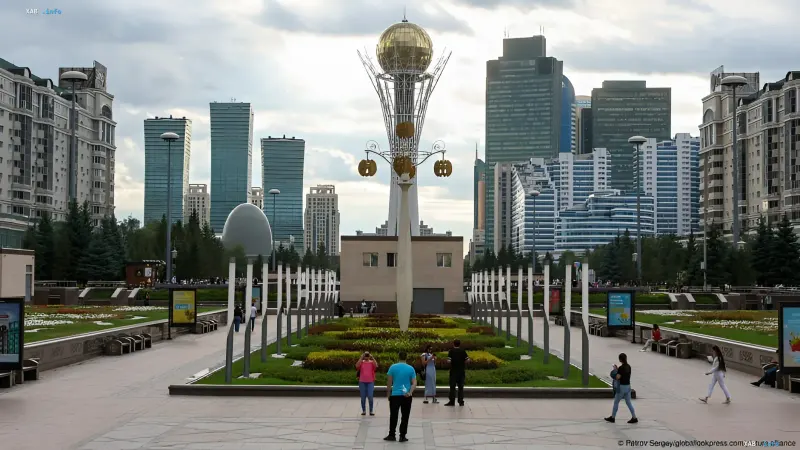
On the morning of November 11, 2026, a special unit of Kazakhstan's National Security Committee (KNB) conducted arrests in Astana that instantly became the country's primary political narrative. Nurlan Zhakupov, Chairman of the Board of the massive investment holding Samruk-Kazyna, and Yelzhas Otynshiyev, head of the national railway company Kazakhstan Temir Zholy (KTZ), were taken into custody. Several others were arrested alongside them, though the security agency has not disclosed their names. The specific details of the criminal case and the roles played by the high-ranking managers remain unknown at the time of publication. Nevertheless, the scale of the arrests—targeting the heads of two systemic state companies—has become an unprecedented signal to the business and public sectors.
Samruk-Kazyna: The Nervous System of the Kazakh Economy
To grasp the scale of current events, one need only look at the asset structure managed by Samruk-Kazyna. The holding effectively functions as a sovereign wealth fund: through it, the state controls national oil and gas operator KazMunayGas, the atomic company Kazatomprom, the rail network, telecom operator Kazakhtelecom, power grid operator KEGOC, and national carrier Air Astana. In essence, Samruk-Kazyna is the conduit through which the state manages a significant portion of the real economy. The simultaneous arrest of its chairman and the head of KTZ means the investigation touches upon several key industries, from oil and nuclear energy to logistics and transport.
Tokayev: A "Great March" and a November 24 Deadline
The day following the arrests, on November 12, President Kassym-Jomart Tokayev held an unscheduled Security Council meeting. He described the incident as an "extremely serious signal of large-scale corruption within state companies" and emphasized that there should be no distinction between "insiders" and "outsiders" in the anti-corruption fight. The head of state instructed the government to prepare concrete proposals for drastically reducing corruption and improving the efficiency of the quasi-state sector by November 24. "We are beginning a great march, the ultimate goal of which is public welfare and prosperity in accordance with the constitutional principles of 'Law, Justice, and Order.' This path will not be easy, it will likely be thorny, but the road is mastered by the walker," Tokayev declared. The use of the phrase "great march" and the strict deadline suggest that the president intends to use the scandal as a starting point for a broader restructuring of state asset management.
Suitcases of Hundred-Dollar Bills: Viral Video and Unconfirmed Estimates
Almost simultaneously with reports of the arrests, videos spread across social media showing suitcases and bags stuffed with hundred-dollar bills being thrown from the window of the elite Atlant residential complex in Astana. Unconfirmed reports suggest the money was tossed from Nurlan Zhakupov's apartment when KNB officers arrived for a search. Law enforcement authorities have not reported who owned the funds, their exact volume, or their origin. According to various media and bloggers, the total amount of cash thrown could have ranged from $25 to $30 million. While none of these figures have been officially confirmed, the video itself became the scandal’s primary visual symbol, sharply intensifying public demand for transparency.
Change in KNB Leadership and Disciplinary Action for Interior Minister
On November 16, Tokayev replaced National Security Committee Chairman Yermek Sagimbayev, who had held the post since January 2022—immediately after the country’s mass riots. His former deputy, Marat Irmenov, became the new head of the special service. During a meeting with the new KNB chief, the president stated the need for reforming national security bodies while simultaneously increasing their operational efficiency. That same day, the presidential press service reported that Tokayev had been informed about the investigation's progress and the arrests. "In the President’s view, security agencies made miscalculations. In this regard, Minister of Internal Affairs Yerzhan Sadenov received a disciplinary penalty. Overall, the corruption component in the case of the Samruk-Kazyna fund and Kazakhstan Temir Zholy executives is beyond doubt. It is confirmed by the actions of the figures involved during the investigation," the official statement read. Thus, within five days of the arrests, personnel changes affected both the intelligence services and the government’s security bloc.
Experts: Systemic Reform or Personnel Purge?
Against the backdrop of the scandal, authorities began discussing the possibility of spinning off the national atomic company Kazatomprom from the state holding and transferring it to the control of the Atomic Energy Agency. Industry expert Telman Shuriyev reported this on Facebook; according to the business publication Kursiv, the issue has been raised repeatedly in the presidential administration and has returned to the center of attention following the arrests of the fund's executives. Economist Arman Beisembayev noted in a comment to DW that neither total state control nor mechanical privatization of Samruk-Kazyna assets is a universal solution: "Keeping everything under state control is bad. But handing assets over entirely to the market is also not the way out." Experts agree that personnel decisions, no matter how drastic, do not in themselves guarantee systemic changes. The key question the government must answer by November 24 is whether it can turn this anti-corruption impulse into a sustainable mechanism for oversight of the quasi-state sector or if the case will remain limited to targeted arrests and the replacement of managers.


