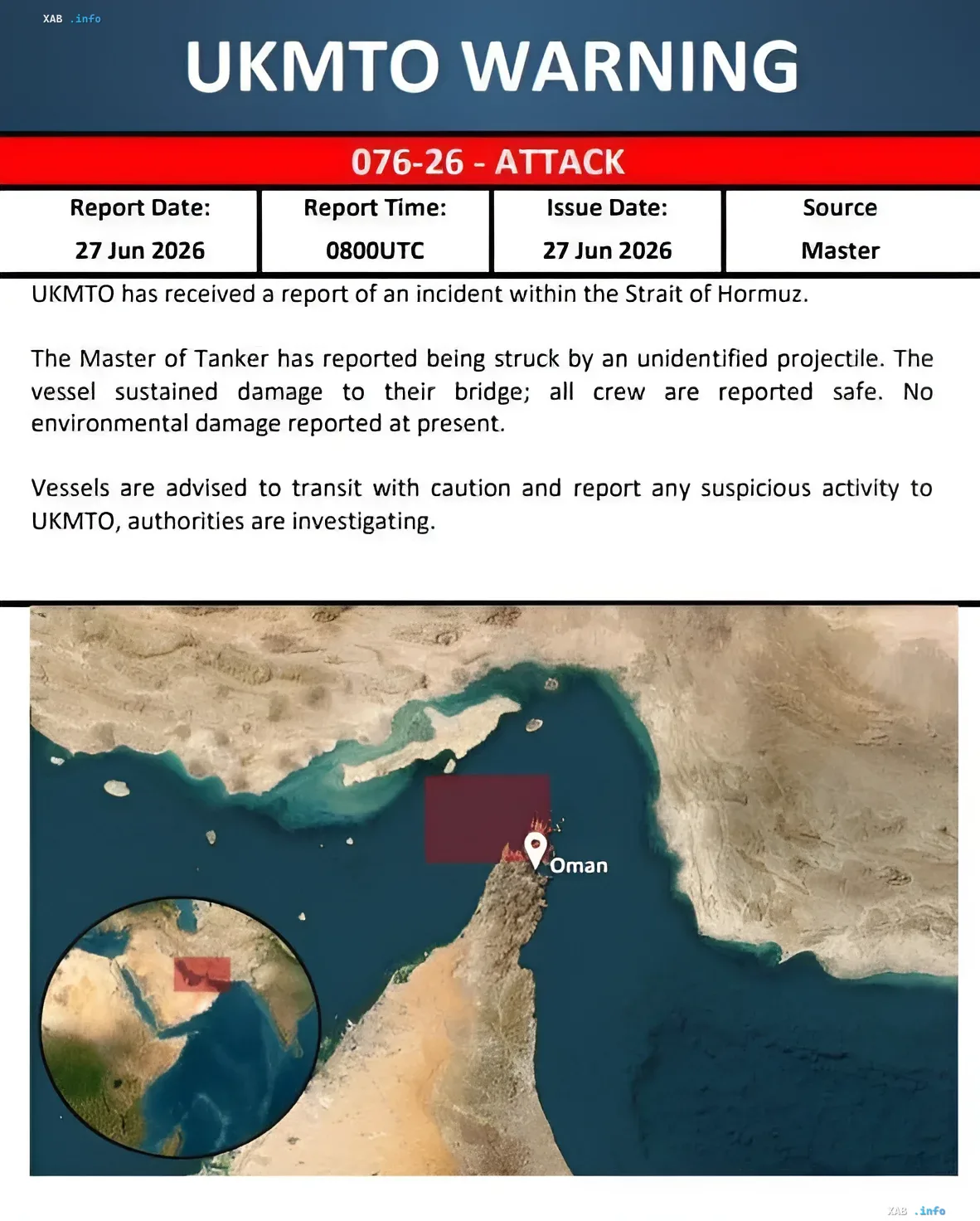
The situation in the Gulf of Oman has sharply escalated following an armed attack on a large commercial vessel. The UK Maritime Trade Operations (UKMTO) recorded the incident, classifying it as a targeted shelling of civilian transport. The attack occurred approximately 7.5 nautical miles southeast of the port of Dahit in the Sultanate of Oman, in close proximity to the strategically vital Strait of Hormuz.
Attack Details and Vessel Status
According to official agency report number 074-26, the captain of the affected vessel reported a projectile hit on the starboard side. As a result of the impact, the superstructure of the bridge was damaged. Fortunately, there are currently no casualties among the crew, and there is no threat of fuel spillage or an ecological disaster.
International maritime security agencies Ambrey and Vanguard Tech identified the target of the attack as the container ship Ever Lovely. The vessel, with a capacity of 9,532 TEU, sails under the flag of Singapore and belongs to the Taiwanese logistics giant Evergreen Marine Asia. Representatives of the shipowner confirmed the incident, noting that despite the damage, the container ship retained maneuverability, left the danger zone, and is continuing its voyage.
Preliminary analysis conducted by US defense agencies indicates the use of a kamikaze unmanned aerial vehicle. The choice of target — the bridge — suggests a tactic aimed at disabling control systems, which is characteristic of Iranian loitering munitions.
Suspension of IMO Humanitarian Mission
The incident occurred against the backdrop of a sharp dispute over shipping regulations. The day before, the International Maritime Organization (IMO), together with Omani authorities, launched a humanitarian evacuation corridor along the southern boundary of the strait. The initiative was intended to evacuate hundreds of merchant vessels blocked in the Persian Gulf since late February 2026 due to the regional conflict.
However, Iran's actions led to an immediate reaction. The Persian Gulf Regional Strait Authority (PGSA) and the Islamic Revolutionary Guard Corps (IRGC) declared the southern corridor "illegal and dangerous," refusing to guarantee safety to vessels that did not coordinate their route with Tehran. Under the threat of coastal missile systems, several tankers, including Blue Star I and SG Pegasus, were forced to alter course.
In response to the attack on Ever Lovely, IMO Secretary-General Arsenio Dominguez officially announced a temporary freeze on the evacuation program. In his statement, he emphasized:
"Although the attacked vessel was not directly proceeding as part of our evacuation column, I have decided to temporarily suspend the implementation of the plan. The safety of seafarers is an absolute priority. The mission will resume only after repeated confirmation of firm security guarantees from all parties involved in the region".
Legal Context and US Response
The situation in the strait has generated sharp legal resonance. In accordance with the 1982 United Nations Convention on the Law of the Sea (UNCLOS), the regime of transit passage applies to straits used for international navigation. Under international law, this regime cannot be suspended or blocked by coastal states unilaterally, casting doubt on the legality of the IRGC's demands.
US Secretary of State Marco Rubio, who is visiting the region, characterized Iran's actions as a direct threat to global energy security capable of destabilizing world oil prices. As a countermeasure, the US Air Force has intensified patrols of the airspace over the Strait of Hormuz to prevent further escalation.


