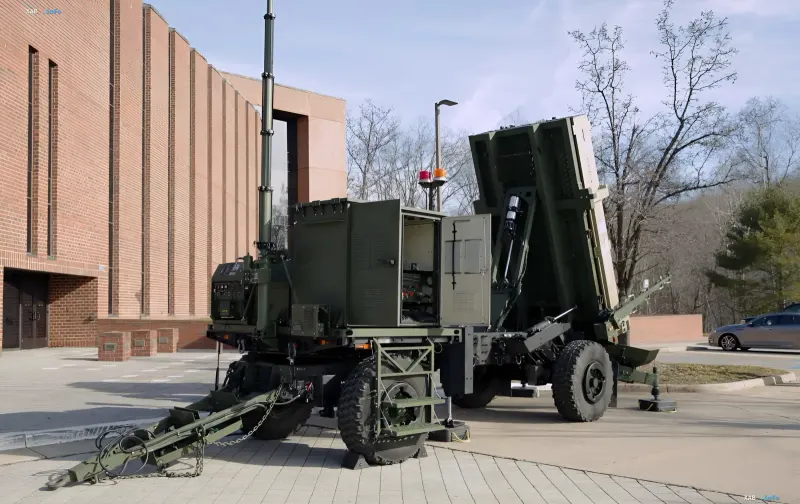
The Australian Ministry of Defense has submitted a request to Washington regarding prices and timelines for the American version of the 'Iron Dome' system, intended to protect military bases and deployed troops from China's long-range weapons. As stated in the tender documentation, the department requested conditions for the Medium Range Intercept Capability (MRIC) system of the US Marine Corps, which uses American variants of the Israeli launcher and missiles. According to the publication, this system could become the foundation of the country's first land-based shield against ballistic missiles. The tender for project LAND 6504 was announced on October 13, 2026.
What exactly is Canberra requesting
Alongside MRIC, the Australian Ministry of Defense is considering the American Patriot surface-to-air missile system and a land-based adaptation of the US Navy's Aegis platform. Bids are also expected from Norway's Kongsberg and South Korea's Hanwha, while Israel's Rafael, the manufacturer of 'Iron Dome' and 'David's Sling', may submit a direct offer. Thus, several technological schools are effectively competing in the tender: American, Israeli, Norwegian, and South Korean.
Schedule, budget, and radar integration
The department aims to select a 'proven' ready-to-use system by the end of 2027 and conduct live-fire tests during the Talisman Sabre exercises in 2029. The winner must also integrate radars from the state-owned CEA Technologies, which, according to the publication, could increase project risks. The Ministry of Defense hopes to achieve initial capability in the early 2030s, with full readiness planned for the middle of the decade. The project budget is estimated at up to 10 billion Australian dollars; however, in April 2026, when the investment program was announced, only 210 million was approved. The system will protect military bases and deployed troops, rather than the entire population, unlike the 'Iron Dome' covering Israeli cities.
SkyHunter vs. ballistics: conflicting tasks
MRIC, already deployed with the US Marine Corps in Okinawa, fires the SkyHunter missile—an American version of the Tamir interceptor, produced by the Raytheon-Rafael joint venture in Arkansas. Each trailer-mounted launcher carries 20 missiles with a range of approximately 70 km. However, the system was designed primarily against cruise missiles and drones, rather than ballistic missiles, which the Australian Ministry of Defense wants to destroy in the terminal phase of flight. Patriot, conversely, has better results against ballistic targets—including the Russian hypersonic 'Kinzhal' in Ukraine—and is likely a priority for the Australian Army. However, a single interceptor costs about 4 million USD, and US stocks have been depleted by the war with Iran; the US Congressional Research Service has warned of potential cancellations of foreign military sales due to difficulties in replenishing stocks. Lockheed Martin Australia, creating a combat management system for the new shield, launched an SM-2 missile from a trailer-mounted launcher via the Aegis system and an Australian CEA radar in June.
Timeline criticism and political risks
The project timeline has been criticized by former Deputy Secretary of the Department of Defense Peter Jennings, who called the schedule a 'fantasy defensive country' and noted that 'medium range is not just missiles, but the procurement itself.' The publication also points out that the decision to consider a system based on Israeli technology could spark criticism from the Greens party and the left wing of the Labor party, who are calling on the Albanese government to sever defense ties with Israel due to the war in Gaza.
Context: American Tamir already in production
Australia is considering missiles whose production was recently established in the USA. On October 7, 2026, the USA handed over to Israel the first fully American-made Tamir interceptor missile, assembled at the Raytheon-Rafael plant in Arkansas. This is the first instance of a complete Tamir missile being produced outside of Israel; previously, American companies supplied only components, with final assembly taking place in Israel. The same plant is expected to produce the SkyHunter for the US Marine Corps' MRIC program, which is directly linked to the Australian tender.