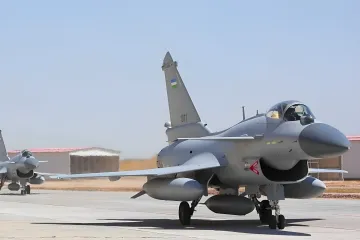
Engineers from the AVIC Chengdu Research Institute, responsible for developing the People's Liberation Army Air Force's primary stealth fighters—the J-20 and the prospective J-36—have publicly stated serious concerns regarding the application of artificial intelligence in the military sector. This warning was issued in a scientific paper published in *Information Studies: Theory & Application*, marking one of the few instances where developers of first and sixth-generation combat aircraft have openly pointed out the limitations of popular AI tools.
Where AI truly accelerates work
According to the specialists themselves, large language models have already demonstrated high efficiency in analytical work. They are capable of rapidly processing large datasets and analyzing weapon characteristics, tasks that previously took human analysts significantly more time. In routine tasks involving information systematization and the preliminary review of technical descriptions, AI acts as a powerful accelerator, allowing designers to navigate huge flows of open and classified information more quickly.
"Direct contradiction to the laws of physics"
However, lead engineer Zhang Xianzhe has called for extreme caution when integrating high technologies into defense projects. According to him, AI-generated content can "directly contradict basic laws of physics, design principles, or real operational limitations." In other words, the model may produce parameters that appear plausible at first glance but are physically impossible or technically unfeasible, making its conclusions unreliable without mandatory expert verification.
Why accuracy is critical in fighter design
The design of any modern fighter begins with an analysis of the potential adversary's capabilities and future battlefield conditions. Designers must have precise answers regarding the coverage zones of enemy radars and the frequencies they use. These parameters form the basis of the aerodynamic scheme, radar cross-section, and electronic warfare complex; therefore, even a minor input error can distort the entire subsequent calculation.
The cost of error at the design stage
Researchers emphasize that, despite high information processing speeds, AI currently cannot guarantee absolute accuracy. "In the high-risk military sphere, where the cost of error is maximized, using unverified data from AI can lead to the embedding of critical defects even at the combat aircraft design stage," Xianzhe summarized. Thus, the authors of the paper do not deny the usefulness of neural networks but insist that in defense engineering, AI must remain a support tool rather than a source for making design decisions.