
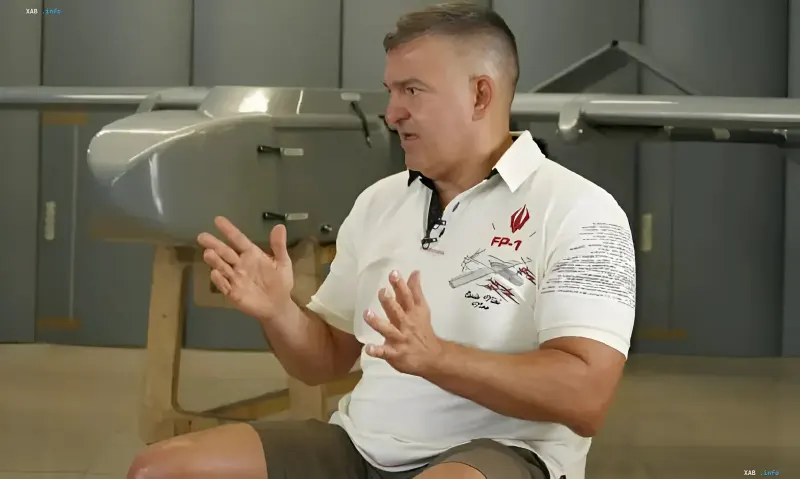
Ukrainian defense industry has moved to the final stage of developing its own ballistic missile. Denis Shtilerman, Chief Designer of Fire Point, confirmed in an interview with LIGA.net that the FP-7 modification project is entering the final pre-flight preparation stage. The key event will be the transition from bench tests to full-scale flight tests, which, according to developers' plans, could begin as early as autumn 2026.
Technical status and import dependence
At present, the technological development cycle is constrained by the need to complete comprehensive engine tests. This is a mandatory procedural step before the start of qualification launches. Fire Point is simultaneously working on several types of weaponry, including the FP-5 "Flamingo" cruise missile and the FP-7 ballistic complex.
However, ambitious plans face a critical dependence on Western technologies. The designer admitted that to complete positioning and control systems, as well as related projects such as the Freya air defense system, stable access to Western technical documentation and specialized semiconductor components is required. Currently, company management is negotiating with US and EU regulators in an attempt to overcome export restrictions.
Tactical goals and characteristics
An analysis of the declared characteristics indicates an attempt by developers to create a weapon capable of overcoming echeloned air defense zones. According to Fire Point management, existing air defense systems do not have sufficient experience in intercepting ballistic targets with variable trajectories. The declared range of the basic FP-7 profile is up to 300 km, but maneuvering on the trajectory becomes the key factor.
Parallel to the ballistic program, the development of the FP-5 "Flamingo" cruise missile is underway, which is currently at the experimental design stage. The goal of the project is to create a long-range strike sector of up to 850 km, however, this process also requires the optimization of turbojet engine imports.
Project implementation schedule
The structure of Fire Point's missile program currently looks as follows:
- Ballistic missile FP-7: Completion of engine bench tests. Goal — transition to combat tests in autumn 2026.
- Cruise missile FP-5 "Flamingo": Optimization of engine imports. Currently at the R&D stage.
- Freya Air Defense Complex: Integration of radar systems. Joint development with partners from the EU.
Risk factors and official position
Official representatives of the Ministry of Defense of Ukraine and the General Staff refrain from detailed comments regarding exact tactical and technical characteristics, citing secrecy protocols. Experts emphasize that the real timelines for putting the missiles on combat duty will depend on the stability of funding and the absence of infrastructure-destructive impacts on production workshops.
The production and testing of weaponry are regulated by the State Targeted Defense Program of Ukraine, as well as export control norms of supplier countries within the framework of international agreements on the non-proliferation of rocket technologies. Thus, the success of the FP-7 project depends not only on engineering solutions but also on complex geopolitical conjuncture.


