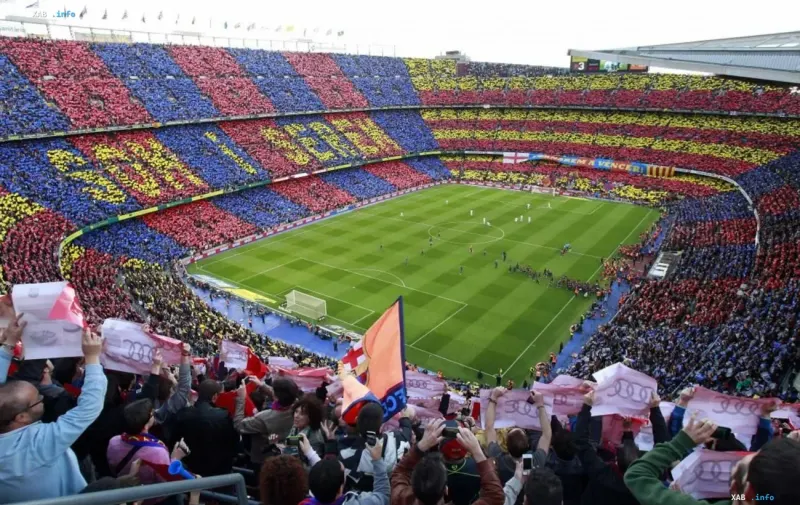
Catalonia's Barcelona has been forced to temporarily leave the renovated Camp Nou once more ahead of the 2027/28 season. The reason for the latest move is the need for a large-scale reconstruction of the arena's roof. Thus, the legendary stadium, which has already gone through a phase of construction and reduced capacity, once again becomes the site of building works, while the team becomes an unwilling guest on other people's pitches.
Current season: playing on a reduced arena
According to available information, Barcelona will finish the current 2025/26 season at Camp Nou, but fans will have to accept a significantly limited capacity. The arena's capacity will be cut to 62,000 seats — in effect, the team will host its opponents on only two tiers of the stands. This means that a significant portion of the stadium's upper sections will remain closed to spectators for the remainder of the season's matches.
Move to the Olympic Stadium and the return timeline
Barcelona will start the 2027/28 season at the Olympic Stadium in Barcelona — the very arena that hosted matches of the 1992 World Cup and the Olympic Games. The move is driven by the installation of a new roof at Camp Nou, which will require the complete closure of the upper sections. The team's return to its home ground is scheduled for January 2028, by which time the stadium will have 95,000 seats. And from the 2028/29 season, Barcelona plans to reach its maximum design capacity of 105,000 spectators.
2029 Champions League Final: a critical deadline
Meeting the reconstruction deadlines is critically important not only for the club but for European football as a whole. Last week, UEFA officially announced that in 2029 the renovated Camp Nou will host the Champions League Final — for the first time in 30 years. This makes the timely completion of all construction work, including the roof installation and bringing the capacity up to design levels, a matter of reputation not only for the Catalan club but for the entire Spanish football infrastructure.
Funding: €510m from Spotify and media bonds
To cover schedule delays and expand the scale of the works, the club's members approved an additional funding package of €510m (around $585m) from Spotify. Of this amount, €300m will be directed directly to completing the construction work at Camp Nou. A further €210m is planned to be spent on issuing media bonds — a financial instrument with a maturity of up to 10 years, secured by La Liga and UEFA broadcasting rights. According to the source, the total cost of the arena's renovation has reached the €2bn mark.
Contradictory data
The provided sources contain a number of details that require clarification. First, Spotify's role as a source of €510m in funding for the stadium's construction work looks atypical for a music streaming service and may point to a complex deal structure (naming, partnership or financial instrument), the details of which have not been disclosed in open sources. Second, the total estimate of €2bn mentioned in the headline of one source and the specific €510m package approved by the club's members describe different budget levels: the former is cumulative, the latter is incremental. The exact funding structure and the parties' obligations are not currently confirmed by an independent audit.
Thus, Barcelona is entering a new phase of the multi-year transformation of its main stadium. For fans, this means at least one more season at a temporary venue, but in the long term — one of Europe's largest football stadiums with a capacity of 105,000 and the status of a venue for the Champions League Final.