

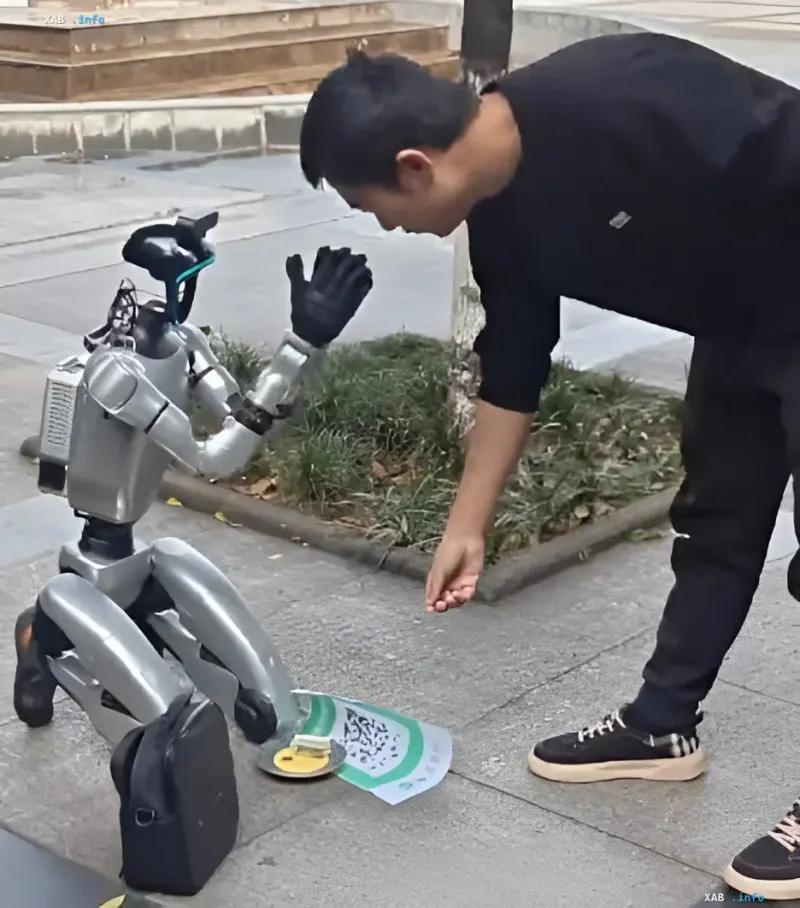
In June 2026, the streets of China's largest megacities — Beijing, Chengdu, and Fuzhou — became the stage for an unusual spectacle. Passersby began encountering anthropomorphic robots imitating the behavior of homeless people. Mechanisms programmed with cyclic body tilts and audio-visual signals were placed in pedestrian zones, attempting to attract attention and collect donations.
Robotics specialists quickly identified these "beggars" as Unitree G1 humanoid robots manufactured by Unitree Robotics. These are high-tech platforms with advanced kinematics (up to 43 degrees of freedom) and sophisticated sensor systems, including 3D LiDAR and depth cameras. However, the high cost of the equipment — approximately $16,000 USD per unit — raises doubts about the economic feasibility of using them for actual money collection.
Experts lean towards the idea that what is happening is not an attempt to earn a living through begging, but a planned social experiment or a viral marketing campaign. The robots are equipped with LED displays bearing messages about a lack of energy and QR codes for transfers via popular Chinese payment systems WeChat Pay and Alipay.

The situation sparked a heated discussion in the Chinese segment of the internet, particularly on the Weibo platform. User opinions were divided: some see this as an ironic deconstruction of fears regarding automation, while others express concern. The main questions concern pedestrian safety, the protection of personal data when scanning QR codes, and the legal status of robots in the urban environment.
At present, there are no official comments from the Ministry of Public Security of the PRC or city administrations. Nevertheless, current legislation on urban order may classify the unauthorized placement of such objects as a violation. At the same time, all QR codes in China undergo identity verification, which allows law enforcement agencies to quickly identify the owners of accounts receiving funds if necessary.


