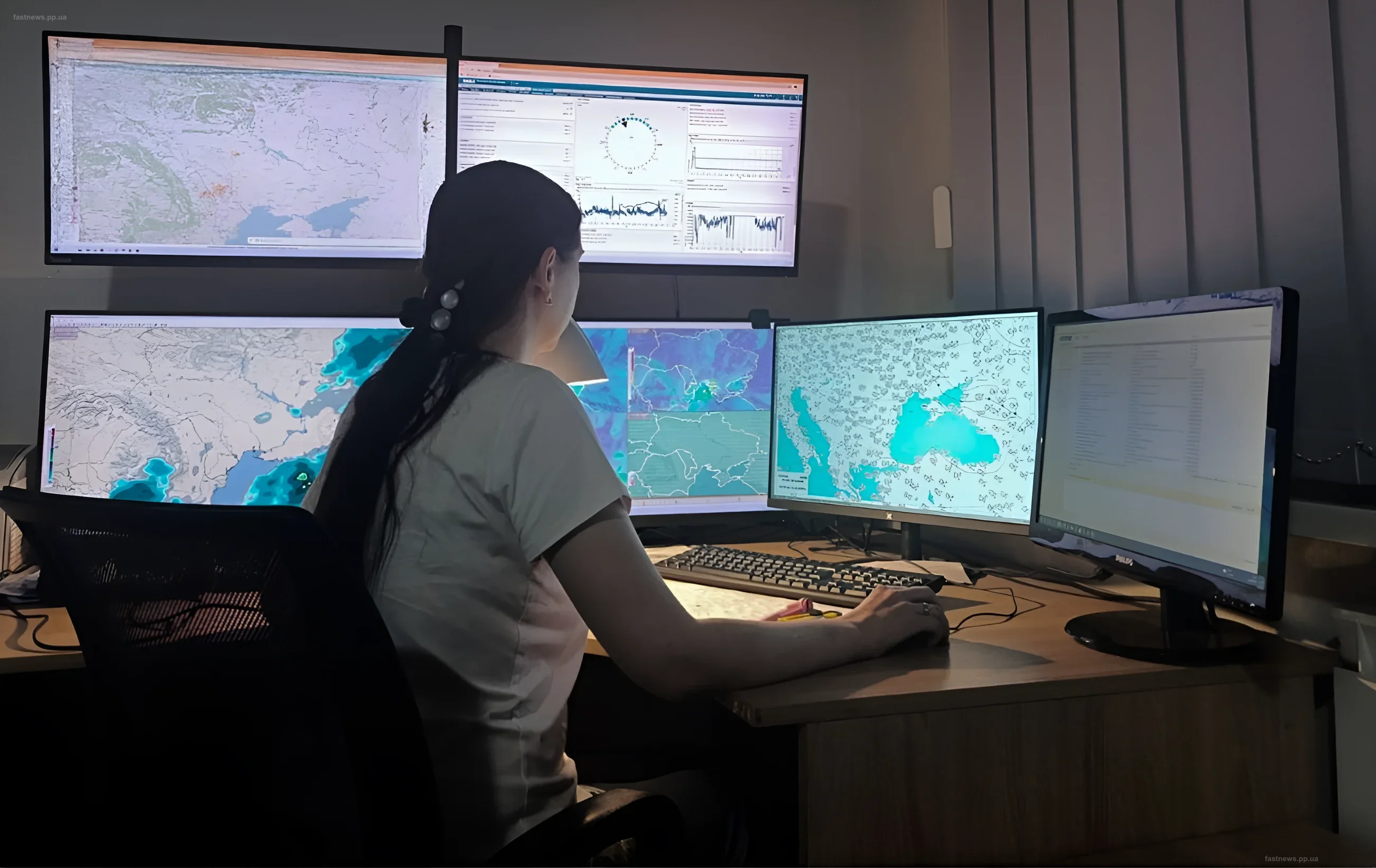
Behind the familiar smartphone notification about rain or thunderstorms lies intense work that knows no weekends or breaks. The Ukrainian Hydrometeorological Center (UkrGMC) has lifted the veil of secrecy, showing that creating a weather forecast is not magic nor just looking at a map, but a complex analytical process upon which human lives and the operation of critical infrastructure depend.
Battle with Atmospheric Chaos
Unlike office employees whose day starts with a cup of coffee and discussing the news, a meteorologist's shift begins with taking over the duty in silence. Before them is a wall of monitors running data from satellites, weather stations, and predictive models. The specialist's task is not just to see the information, but to interpret it, filtering out false signals.
The atmosphere does not adhere to a schedule. A model may "predict" a thunderstorm, but only human experience can determine if it will be dangerous, exactly where lightning will strike, and how strong the gusts will be. Sometimes the difference between a harmless rain and a warning of a natural disaster lies in a temperature fluctuation of a few degrees or a barely noticeable shift in the atmospheric front.
The Language of Numbers and Responsibility
Phrases we hear on TV — "local short-term rain" or "wind gusts" — are for a meteorologist the result of analyzing dozens of parameters. Every word carries a risk assessment:
- "Light rain" means local precipitation from cumulonimbus clouds that will end quickly.
- "Thunderstorms in some areas" is a signal that thunderstorm activity will be focal, not continuous.
These formulations do not just inform citizens; they are the basis for decision-making by rescuers, energy companies, aviation, and utility services. The accuracy of the forecast determines whether the population will be evacuated in time before a flood or if power lines will be disconnected before a hurricane.
A Living Process
The weather forecast at UkrGMC is not a static document, but a living, continuous process. The synoptic situation can change in a matter of hours, so monitoring is conducted around the clock. Each region has its own centers that adjust data in real-time, coordinate warnings, and monitor changes.
When you look at the sky and see an approaching cloud, somewhere in the control center, they have already been observing it via satellites for several hours, comparing figures, and deciding whether to report a danger. This is work where the price of error is too high, and the responsibility for every forecast rests on the shoulders of professionals who watch the sky so that we can calmly plan our day.


