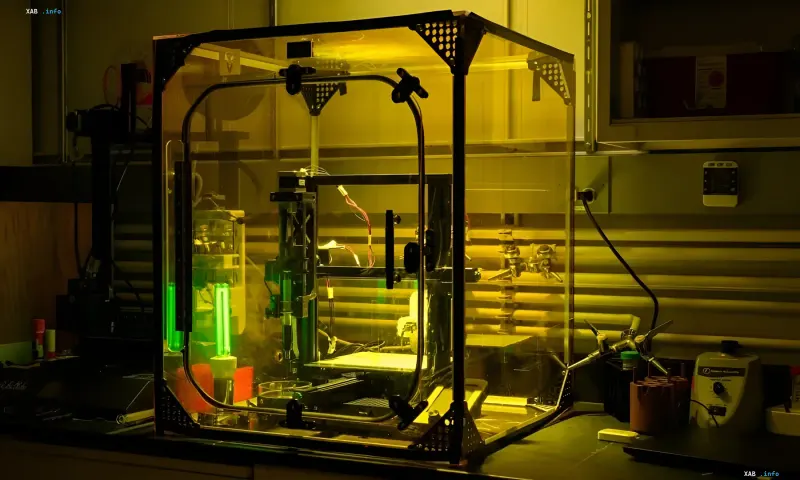
Researchers from the University of Rochester and Cornell University (USA) have demonstrated that you do not need industrial setups costing over $100,000 to create a functional bioprinter. The team retrofitted a common hobbyist Creality Ender 3 3D printer, spending about $450 on equipment and modifications, to produce a device capable of printing 3D structures out of living bacteria up to 100 layers high. The results were published in the journal ACS Applied Polymer Materials. For homemade bioprinters, this is five times the previous practical limit—around 20 layers—where similar setups typically failed due to soft material deformation.
How the Low-Cost Bioprinter Works
Instead of a standard print head where plastic is melted and pushed through an extruder, the researchers installed a pump that delivers bio-ink—a mixture of living microorganisms and a polymer solution—through a syringe. A key feature of the unit is that it not only extrudes material but also sucks it back between nozzle movements. This reverse flow allows for more precise control over the flow and prevents ink from spreading beyond the intended shape. According to the authors, this configuration reduced random bacterial deposition by nearly 100 times, making the edges of the printed elements significantly sharper.
The Sagging Problem and Its Solution
The main obstacle for previous DIY bioprinters was that the soft gel would sag before it could solidify; each new layer would deform under its own weight, making it impossible to produce structures taller than 20 layers. To solve this, the researchers placed the print head in a support suspension of tiny particles of gelatin or agarose—a polysaccharide derived from seaweed—mixed with calcium chloride. This medium holds each fresh layer in place to prevent deformation while the alginate-based ink (a natural polymer from brown algae) sets. As a result, the device is capable of creating not only solid but also hollow cylinders and lattice structures. In a preliminary version of the study, a 100-layer structure almost 22 mm high was demonstrated.
Two Media Options and Cell Viability
The geometry of the printed forms is also important for the microorganisms themselves: hollow structures provide a larger surface area through which bacteria can obtain nutrients and release metabolic products. The scientists developed two types of supporting media. The gelatin suspension can be removed after printing by extracting the finished structure. The agarose version, by contrast, remains around the structure and serves as an incubator. While previously printed bacteria would begin to die after about 9 days, in an agarose medium with added nutrients, Escherichia coli maintained viability for four weeks.
Purpose and How to Replicate the Development
The work continues more than a decade of research by lead author Anne Meyer’s laboratory, focused on creating living structures to study antibacterial technologies and wastewater treatment. Sustaining bacterial viability for longer periods will allow the creation of artificial biofilms—communities of microorganisms that attach to surfaces. Depending on the strains used, these structures could be applied to clean contaminated water or degrade plastic. The researchers have uploaded the STL files and G-code to GitHub, enabling laboratories and enthusiasts who already own an Ender 3 printer to replicate the development themselves.