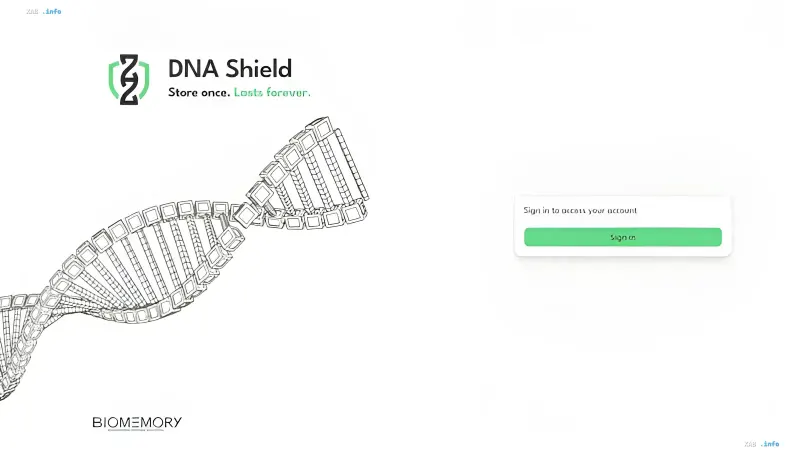
French company Biomemory has announced the launch of DNA Shield, a commercial data storage and protection service based on encoding information into synthetic DNA. The solution is positioned as the first product in the "molecular IT" lineup that the company intends to develop going forward. The early access program is already open for organizations that require autonomous and independent protection of critical digital assets—information that must remain accessible and reliable for years and decades, regardless of threats that may arise both now and in the future. As seen in the screenshots, the service website uses the concise slogan "Store once. Lasts forever."
Architecture: From Encryption to Molecular Medium
The operational principle of DNA Shield is built around multi-level security. The client selects the information to be preserved and encrypts it. Next, the service encodes the encrypted data into synthetic DNA, which is stored autonomously, offline, and under strict operator control. A fundamental feature of the architecture is the absence of mechanisms for regular or independent client access to the stored data: the extraction procedure is initiated strictly when necessary. According to the developers, this approach ensures the recovery and verification of data even under conditions of cyberattacks, organizational restructuring, complete replacement of IT infrastructure, or government audits.
Use Cases: From Encryption Keys to Reference Records
Biomemory highlights several key application scenarios. The first is maintaining the operability of encryption key recovery systems in situations where other people or service providers take them over. In this context, DNA Shield complements Hardware Security Modules (HSMs) without claiming to replace them. The second scenario is the protection of high-value intellectual property: creating autonomous and independent copies of critical formulas, technological processes, or project parameters whose loss would be unacceptable to the company. The third is generating records whose integrity must comply with regulatory requirements: an independent copy protected against unauthorized changes serves as proof that critical records have not been modified since their approval. The fourth scenario is the long-term storage of reference records, useful for organizations needing to ensure data retention for periods exceeding the lifespan of the systems that created the data or the companies themselves.
Acquisition of Catalog Technologies and the Competitive Landscape
A strategic step preceding the launch of DNA Shield was Biomemory's acquisition in March of the assets of Boston-based Catalog Technologies, which the company describes as "a pioneer in DNA-based data storage and processing." Biomemory emphasizes that the deal combined complementary technologies, intellectual property, and the expertise of both teams. Other players are already present in the DNA data storage market, including AtlasBase and Mimulus, which offer conceptually similar solutions. Thus, DNA Shield enters a market where competition is forming, but the niche remains highly specialized and oriented primarily toward corporate and government clients with specific requirements for longevity and storage autonomy.
Context: Why "Molecular IT" Is Becoming a Distinct Class
The launch of DNA Shield fits into a broader trend toward seeking alternative information storage mediums capable of surviving both technological and geopolitical shifts. Synthetic DNA as a medium has a theoretical storage density orders of magnitude higher than traditional magnetic or optical media and, under proper conditions, can preserve information for centuries. By positioning DNA Shield as "the first of a group of molecular IT products," Biomemory is effectively signaling its intent to build an entire product ecosystem around this technology. For organizations working with data whose value is not measured by current operational load but by its strategic significance over a multi-decade horizon, such approach is of interest as a supplement to existing backup and disaster recovery mechanisms.