
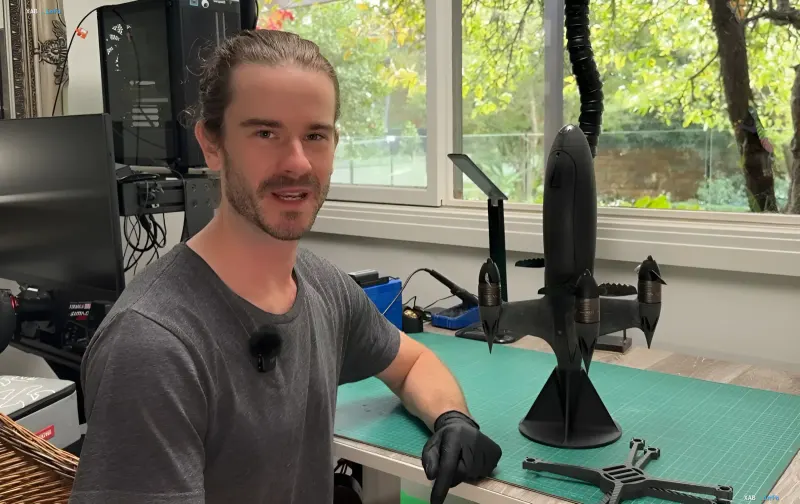
The world of radio-controlled aviation has been shaken by new achievements. A team of Australian engineer-bloggers, Aidan Kelly and Ben Biggs, has unveiled their new project — the Blackbird quadcopter. This aircraft managed to significantly surpass the current world speed record for drones.
Engineering Breakthrough: Toothed Rotors
The main secret behind Blackbird's success was a radical redesign of the propeller system. The engineers abandoned standard solutions in favor of carbon rotors with a high pitch and a unique toothed leading edge. It was precisely this geometry that allowed the aircraft's maximum speed to increase by nearly 80 km/h compared to previous generation analogues.
The essence of the innovation lies in aerodynamics. The toothed structure forces the airflow to move strictly along the blade. This drastically reduces drag, which in ordinary propellers arises due to air being displaced sideways.
Extreme Testing and the Cost of the Record
Achieving such speeds required the technology to operate at its limits. The drone's electrical system withstood a current of 400 amperes for 10 seconds. This led to critical overheating: the batteries began to smoke immediately after landing.
The tests were conducted in difficult weather conditions. Strong winds, with gusts reaching 60 km/h, forced the team to conduct a series of launches in opposite directions to calculate an objective average result. Despite a hard final landing and some damage, the drone's structure remained repairable.
Drawbacks and Prospects
The developers honestly admit that the system has a significant drawback. At low RPMs, the efficiency of the toothed propellers drops significantly, creating extreme stress on the power blocks during takeoff.
At the moment, the result is considered unofficial, as there was no certified Guinness World Records observer present at the venue. The official title still belongs to Mike and Luke Bell from South Africa, whose record stands at 657.59 km/h.
It is important to note that the project authors plan to open up the technology to the community. Soon, pre-orders for detailed digital blueprints of the Blackbird will start on their website. Most body elements are adapted for printing on standard FDM 3D printers, while complex components, such as custom circuit boards and carbon fiber, can be ordered from specialized suppliers. Experts already predict that the idea of toothed propellers may be adopted by manufacturers of commercial and military UAVs.


