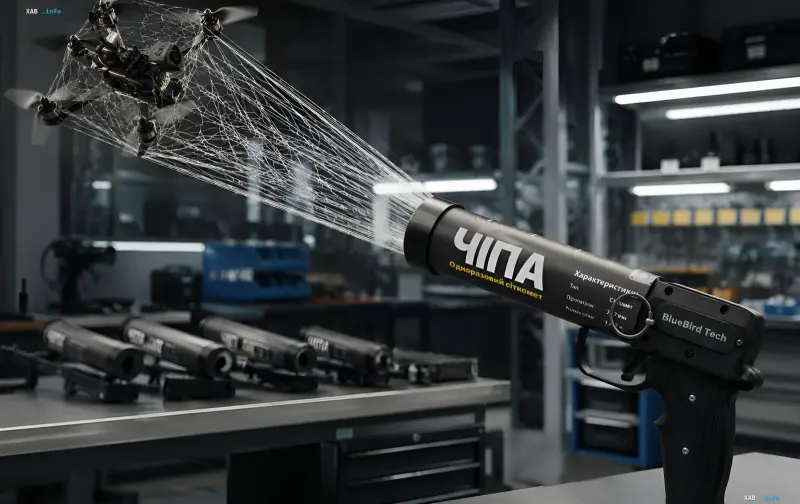
BlueBird Tech has begun serial production of the 'Chipa' net launchers — compact systems designed to intercept FPV drones at close range. This solution aims to protect not only military personnel but also civilian infrastructure, journalists, and volunteers working near the front lines.
Scaling up production
The company stated that planned capacity allows for the production of over 500 net launchers per month. The equipment will be supplied to the Armed Forces of Ukraine, as well as to representatives of critical infrastructure and civilians requiring additional protection against drone threats.
"The threat from FPV drones today affects not only the military. The enemy is increasingly attacking logistics, civilian infrastructure, journalists, and volunteers working near the front lines. That is why we decided to scale up the production of 'Chipa'," noted at BlueBird Tech.
How the 'Chipa' net launcher works
The 'Chipa' net launcher is designed in a pistol form factor and is intended to intercept drones by deploying a special net. The effective range is up to 25 meters. After pulling the trigger, a pyrotechnic cartridge ejects the net, which expands in a 3x3 meter space, tangling the drone's propellers and preventing it from attacking the target.
Unlike small arms, the net launcher does not require high precision to hit a specific point on the target. Thanks to the large deployment area of the net, it covers significantly more space as the drone approaches, increasing the chances of a successful interception. Furthermore, 'Chipa' does not reveal the user's position during operation.
A tool for the last line of defense
The company emphasizes that the net launcher serves as a tool for the last line of defense — when an FPV drone has already approached the target and there is almost no time left for other countermeasures. Preparation to use the net launcher takes only a few seconds: simply remove the safety, aim, and pull the trigger. The net deployment takes 0.2 seconds.
Context of cooperation with Germany
Previously, Ukraine and Germany signed an agreement on the joint production of BARS drones — the first phase is funded by the German side, and all manufactured equipment will be immediately transferred to the front. In April, Kyiv and Berlin agreed on a cooperation package worth 4 billion euros, providing for the supply of hundreds of missiles for Patriot systems and drones.
Also, earlier RBC-Ukraine learned from the founder and CEO of Ratel Robotics, Taras Ostapchuk, where domestic ground drones are going. These data indicate a growing interest in the development and implementation of new technologies for countering drones at both the state and private levels.