
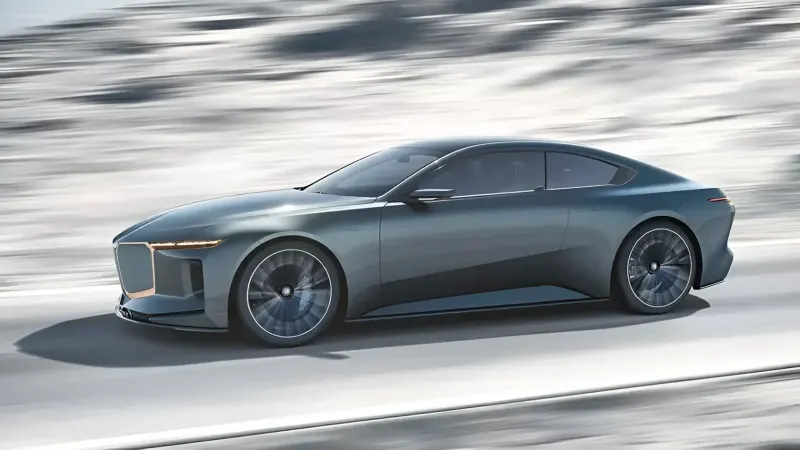
The return of the legendary "shark nose" silhouette is not just a nod to nostalgia for the 70s, but a genuine engineering puzzle. It turns out that agreeing with regulators on pedestrian safety is far easier than fitting a multitude of modern radars into the car's sharp "nose." BMW ALPINA decided to bring back that specific look that fans have missed for decades, but reality proved to be more complex than design sketches.
Aesthetics vs. Electronics
The Vision BMW ALPINA concept, inspired by the classic 6 Series (E24), looks like a collector's dream. However, behind the aggressive slope of the front section lies a serious technical challenge. As it turns out, the main problem is not that the sharp nose might injure a pedestrian—modern materials and deformation zones allow these restrictions to be bypassed without losing points in safety tests. The real pain point for designers is the "insides" of autonomous systems.
Maximilian Missoni, who heads the luxury segment design and ALPINA, states directly: integrating radars, laser scanners, and cameras into such a narrow and sharp element is the most difficult task of modern times. You cannot simply stick a sensor on top, as that would ruin the entire aesthetic. Every millimeter of area under the "nostrils" became a battlefield between electronic engineers and artists.
Design Victory at the Nürburgring
Interestingly, the Skytop and Speedtop models, which have already gone into limited production (50 and 70 units respectively), managed to maintain the purity of lines despite the presence of all necessary sensors. This gives hope that future production BMW models will not turn into plastic-covered devices on wheels. Even in the targa version, recently spotted during tests at the Nürburgring, the "shark nose" looks organic, although hidden behind it is more computing power than some supercomputers of the last decade.
The Future with V8 and Electricity
Although the Vision BMW ALPINA remains only a design study for now, logic suggests: we are seeing the new face of the brand. In 2027, we will see a reimagined 7 Series with a V8 engine, and subsequently a new X7. And although the world is actively moving towards electricity, ALPINA is still holding on to eight cylinders and inline-sixes. Although the closed radiator grilles on the concept already hint at inevitable electrification. The main thing is that behind all these "smart" systems and lidars, that specific analog character that we love these cars for does not disappear.
While BMW ALPINA experiments with retro forms, other manufacturers are not standing still, offering powerful hybrid solutions. For example, the new Audi RS 6 promises to bring back the sedan body and impress with power of over 700 horsepower.


