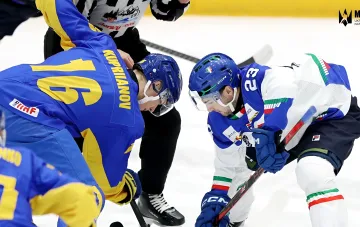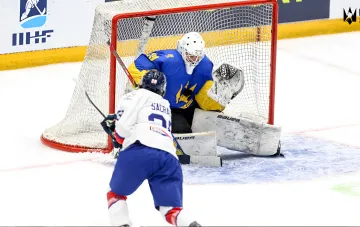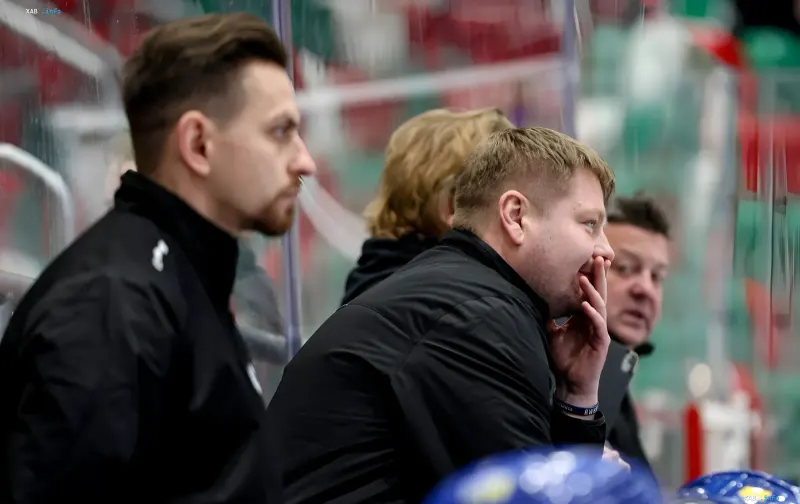
The Ukrainian national ice hockey team, led by new head coach Oleksandr Bobkin, secured three victories in the first stage of the 2026/27 European Ice Hockey Challenge, defeating Poland (2:1), Great Britain (5:1), and Italy (3:2). For Bobkin, who replaced Dmytro Khrystych in the off-season, this tournament was his debut at the helm of the team. According to the coach, the main task at this stage was not so much achieving a result as getting acquainted with the roster and introducing a fundamentally new style of play, which differs from the system used under Khrystych and Oleh Shafarenko.
«I didn't think about the result at all»
In a comment to Suspilne, referenced by Sport RBC.UA, Bobkin admitted that before the tournament started, he was worried not so much about how the team would play, but about how the players would perceive the tactical changes. «It was important for me to get to know the guys. And the fact that it turned out this way and we even managed to win — kudos to the guys for playing like that,» the coach noted. His greatest concern was the opening match against Poland, for which the team had only three days to prepare. At the same time, Bobkin was satisfied with the second and third periods of that encounter. The match against Great Britain, in his estimation, was of a somewhat lower level, partly due to a weaker opponent. In the game against Italy, the coach highlighted the character of the Ukrainians: the team was trailing before the final period but managed to snatch a 3:2 victory.
New model: more work, less time per shift, more aggression
Bobkin explained the key differences of his playing system from the previous one. «A little more work on the ice, reducing the time spent on each shift, and playing a bit more aggressively. I won't go into details, but of course there are many: for each zone, for every piece of the ice,» the coach said. At the same time, he emphasized that it is still too early to evaluate the effectiveness of this model in matches against the world's strongest national teams. For a full test of Ukraine, sparring matches against teams from the elite division of the World Championship are necessary — the very division that the national team reached for the first time in 20 years in May 2026 under the leadership of Dmytro Khrystych.
December stage and roster rotation
The Ukrainians will play the second stage of the 2026/27 European Ice Hockey Challenge in December. The team's opponents will be the national teams of France, Poland, and Hungary. During the next international break, the coaching staff plans to carry out a significant rotation: four forwards and one defenseman will be dropped from the current roster. Instead, the coaches intend to take a look at a number of players performing abroad. In particular, Bobkin expressed hope of attracting Ignat Paziy from the NCAA and Danylo Korzhyletskyi. The coaching staff would also like to see Mykhailo Symchuk in the lineup, but the player has encountered visa issues. Separately, the coach mentioned Ivan Korodyuk, Mykhailo Danylov, and Mykyta Ivashchenko, who study and play in the NCAA, but their universities and teams have not yet released the players to the national team.
Goaltending line: the trio confirmed
Bobkin also focused on the performances of the Ukrainian goaltenders during the first stage. The coaching staff confirmed that the main goaltending trio remains Artur Ohandzhian, Bohdan Dyachenko, and Oleksandr Levshyn. Young Nazar Boyko did not get playing time this time. As the coach explained, it was important for the team to give Dyachenko two consecutive matches, as this is the exact format scheduled at the World Championship. Bobkin was satisfied with the goaltenders' performance and confirmed that this trio is the base for the Ukrainian national team.
Thus, Bobkin's debut cycle at the head of the national team ended in complete success in terms of results and laid the foundation for further rebuilding. The nearest test for the new style of play will be the December stage in the company of France, Poland, and Hungary, as well as subsequent friendly matches against elite division teams, which will make it possible to objectively assess whether the proposed system can compete at the highest level of world ice hockey.