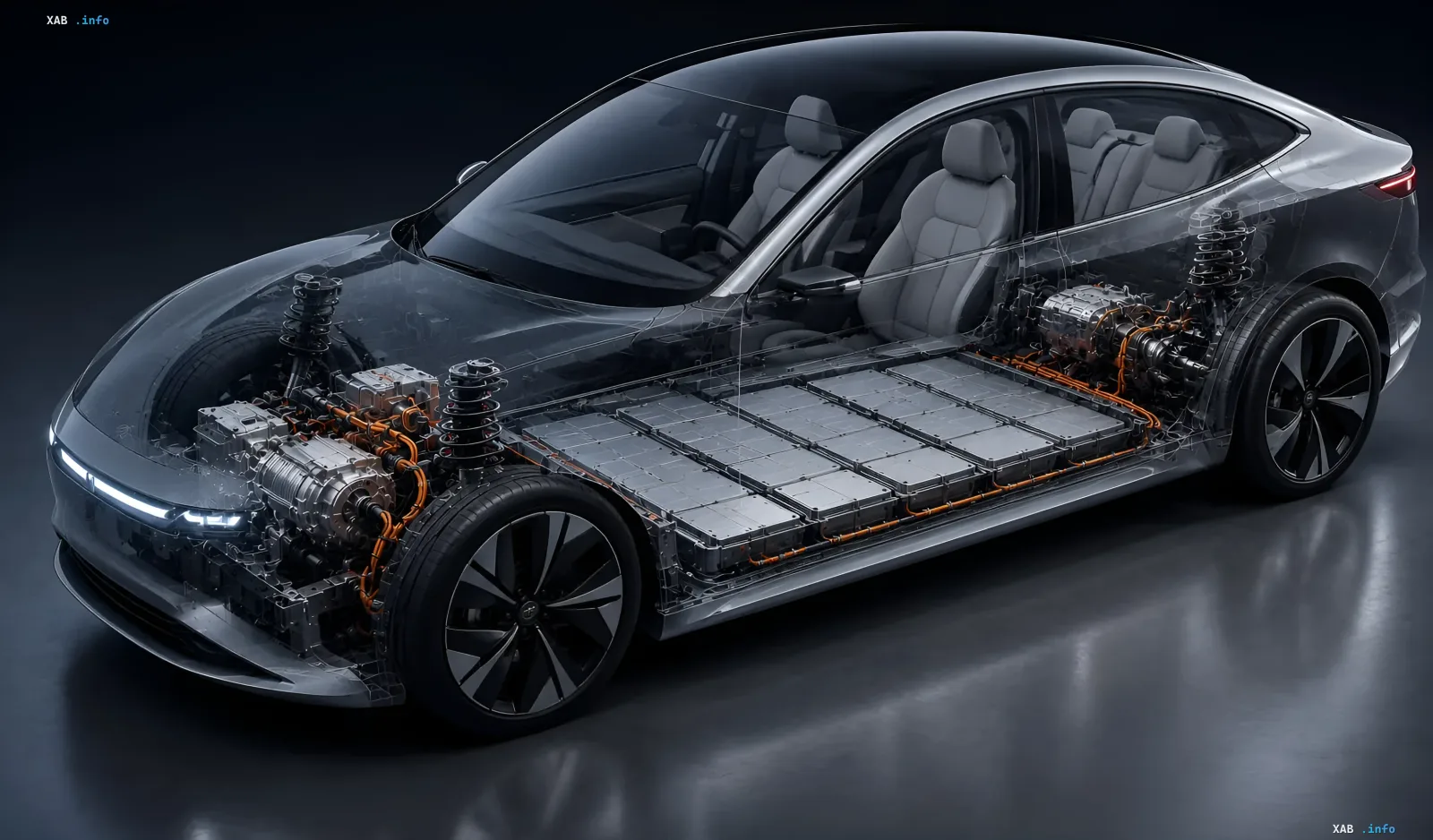
Tokyo. A group of researchers from Shibaura Institute of Technology (Japan) has announced the development of a new type of catalyst that could be the key to the commercialization of lithium-oxygen batteries. This technology promises to revolutionize the energy storage sector, allowing electric vehicles to cover distances inaccessible to modern models and significantly extending the autonomy of drones and other devices.
According to data published on the ixbt.com portal, the new development eliminates one of the main problems of lithium-oxygen batteries — the dependence on expensive and rare precious metals as catalysts.
Limits of the Lithium-Ion Era
The modern electric transport industry and consumer electronics rely on lithium-ion batteries. However, according to experts, this technology is approaching its theoretical limit. The energy density of modern batteries is growing, but with each generation, the increase becomes less significant, while the cost of materials rises.
Lithium-oxygen (Li-O2) batteries are considered the main candidate to replace the current standard. Theoretically, they are capable of storing 10 times more energy than traditional lithium-ion counterparts. This opens the way to creating electric vehicles with a range of 1,000–1,500 km on a single charge, as well as drones with multi-day flight times.
The Secret Lies in Composite Materials
The main obstacle to the mass adoption of Li-O2 batteries was the instability and low efficiency of the electrochemical reactions necessary for charging and discharging. Usually, catalysts based on platinum or ruthenium oxide are used to accelerate these processes — materials that make batteries extremely expensive.
Scientists from Shibaura have proposed a fundamentally different solution. They created a composite catalyst by combining two types of oxide materials:
- Perovskite — a class of materials with unique electrophysical properties;
- Spinel — a structure often used in battery cathode materials.
During testing, this hybrid material showed results superior to the individual components. In particular, during the charging phase, the new catalyst proved more efficient than commercial ruthenium oxide, while during discharge, it demonstrated characteristics comparable to platinum.
Contradictory Data
Although laboratory results look promising, there are different assessments of the prospects for implementation within the scientific community. On the one hand, the authors of the study emphasize that high performance depends on the electronic structure of the material, not the surface area, which opens new avenues for design. On the other hand, experts note that the transition from a laboratory sample to serial production requires solving numerous engineering tasks, including ensuring battery longevity and stability of operation at various temperatures. At the moment, the technology is at the stage of fundamental research, and exact market release dates have not been announced.
Potential Areas of Application
If the development can be scaled, its impact will extend far beyond the automotive industry. According to specialists, the technology will become critically important for:
- Electric Transport: significant increase in range and reduction in battery cost.
- Aerial Mobility: increased flight time for drones and electric aircraft.
- Power Grids: creation of powerful energy storage systems for solar and wind power plants, allowing for the accumulation of excess "green" energy.
- Hydrogen Energy: the technology can be adapted for the production of "green" hydrogen.
Conclusions
The development by Japanese scientists demonstrates that the path to ultra-powerful batteries lies not in the search for new chemical elements, but in the innovative combination of already known materials. Although many years will pass before the first serial electric vehicles with lithium-oxygen batteries appear, this breakthrough in the field of catalysts could become the very "trigger" that accelerates the transition to a new era of energy independence.