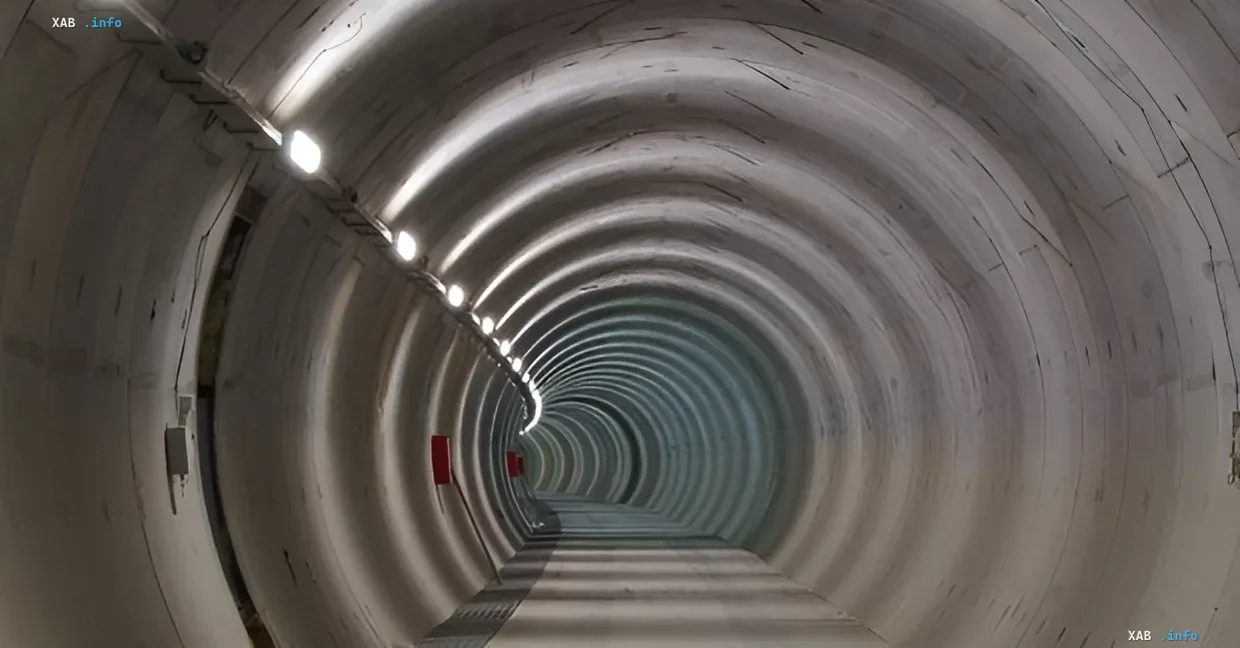
A historic moment is arriving in the history of European transport. After 19 years of continuous work carving a path through massive rock formations, engineers have reached a decisive point in the construction of the Brenner Base Tunnel. In the coming weeks, the excavations from Austria and Italy are set to meet, marking the breakthrough of the first main gallery of this giant.
The Longest Tunnel in the World
The project, which already claims the title of the longest railway tunnel on the planet, has a length of 64 kilometers. It will pass directly under the border of two countries, connecting them through the Alpine range. The symbolic meeting of the drillers will be the culmination of one of the most ambitious infrastructure initiatives in Europe.
The name "base" tunnel was given due to its geometry. Unlike old routes where trains had to overcome steep ascents and descents, this tunnel will pass through the main ridge with almost no gradients. This will fundamentally change logistics: passenger trains will be able to reach speeds of up to 200 km/h, reducing travel time by a whole hour compared to the traditional pass, where speed is limited to 60–80 km/h.
Economy and Ecology: Betting on Freight Transport
The main goal of the project is not just to speed up movement, but to radically change the structure of freight transport through the Alps. Currently, about 2.4 million trucks pass through the Brenner Pass annually. This figure has grown by 50% since 2000 and by a quarter since 2010. Narrow Alpine valleys suffer from noise, emissions, and intense traffic.
The new tunnel is intended to redirect this flow onto the rails. Thanks to the absence of steep climbs, freight trains will not require two locomotives, as they do now. One powerful diesel locomotive will be able to pull heavier and longer trains, making rail transport cheaper and more reliable. The strategic goal is to increase the share of rail freight transport from the current 27% to 50% by 2040, while the total volume of transport should triple.
Finances and Implementation Challenges
The price tag is colossal. As of 2023, the cost of the project was estimated at 10.5 billion euros. The European Union, recognizing the pan-European significance of the infrastructure, intends to allocate 2.3 billion euros for its implementation. However, the path to completion has not been smooth.
Construction has faced serious difficulties: rising prices for building materials and disputes with the construction consortium led to a halt in drilling work in Austria for about a year. Consequently, experts fear that the final launch, scheduled for 2032, may be delayed by another one or two years. An updated work plan is expected to be presented this year.
Lessons from the Gotthard
The effectiveness of the Brenner Tunnel raises questions among experts who look at the experience of the Swiss Gotthard. That project, undoubtedly, streamlined transport and increased the share of railways, but failed to completely eradicate road traffic. Political goals to massively shift freight from roads to rails were only partially achieved there.
The success of Brenner will depend not only on the quality of construction but also on external factors: the transport policy of neighboring countries, the logistics costs of carriers, and the willingness of businesses to switch to more eco-friendly, but perhaps requiring a restructuring of supply chains, solutions. Nevertheless, the Austrian pass remains the most used in the Alps largely because Austria, unlike Switzerland, is a member of the EU and has softer regulatory restrictions.
Before 2032, when the tunnel is supposed to start operating, there is still a lot of work to be done: laying tracks, installing overhead lines, and safety systems. If the project is implemented in full, it will become not just an engineering marvel, but also a key tool in the fight for the ecology of the Alpine region.


