
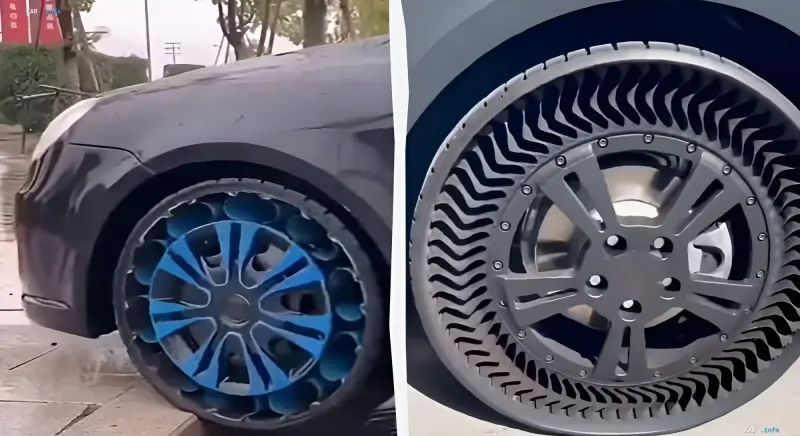
The Japanese tire industry has taken a step that many considered impossible. After 18 years of intensive development, Bridgestone has launched the mass production of AirFree airless tires. This is the first time in history that passenger tires of this type have been officially approved for use on public roads in Japan. However, behind the innovative design lies a serious compromise: the maximum speed on such wheels is limited to just 20 km/h.
Technology That Couldn't Be Born
The idea of creating tires without a tube or air has been in the air for two decades. Major global manufacturers regularly demonstrated concepts of such structures, promising to forget about punctures and flat tires. The first serious attempt was the Michelin project presented back in 2005. The French giant used spokes made of polyurethane and even launched production for construction machinery in 2012, but it never reached the mass passenger car segment.
Bridgestone began work on its own version in 2008, first showing the prototype to the public in 2011. Now, more than a decade and a half later, the project has moved from the stage of laboratory tests to real life. The new tires are made of a special rubber compound with the addition of recycled plastic, highlighting the environmental focus of the project.
Physics vs. Comfort
The main advantage of AirFree is obvious: they physically cannot be punctured or lose pressure. However, engineers had to face the fundamental laws of physics. The tire structure, consisting of flexible lamellae, provides cushioning but demonstrates extremely low resistance to lateral loads.
When moving at high speeds, centrifugal force becomes a critical factor. If a driver attempts to enter a turn at 70 km/h, the flexible elements of the tire will shift to one side, causing the metal rim to touch the asphalt. This makes operation at normal speeds impossible and dangerous. Furthermore, the lamellae limit the ability to absorb road irregularities and the reliability of emergency braking.
Who Needs Such Tires?
Due to the strict speed limit of 20 km/h, the scope of application for AirFree is currently extremely narrow. The first owners of the novelty will be commercial fleets in the Japanese city of Higashiomi. The tires will be installed on small electric cars, resembling elongated golf carts, which are used as public transport for the elderly.
Installing such tires requires special wheel rims, and the vehicles themselves must be adapted to the new design. The bright blue color of the tires was chosen not just for design—it ensures better visibility on the road, and at night, the tire demonstrates a slight fluorescent effect.
The Future in Space?
Experts note that under normal road conditions, tires with a speed limit of 20 km/h look more like a technical curiosity than a practical solution. However, experts see the real potential of this technology in the space industry. The airless structure is ideal for future rovers and Mars rovers, where the risk of puncture on the uneven surfaces of other planets is a critical factor.
Bridgestone has not yet announced plans to increase the allowable speed for the mass-produced version, although it expresses a desire to improve performance in the future. For now, the world watches as innovations find their place in niche segments, while in the automotive service sector, other technologies are developing in parallel, such as robotic tire replacement systems capable of reducing service time to 30 minutes.