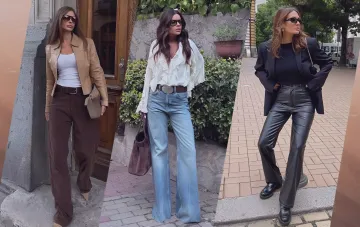
In the Autumn 2026 season, the brooch has finally stepped out of the shadows of the 'classic suit' and 'old-fashioned look,' transforming into a universal accent that stylists recommend pairing with basic clothing, knitwear, outerwear, and even non-clothing accessories. According to the Styler project (RBC-Ukraine) and parallel recommendations from Russian publications (Kleo, m24, glavred.info), the key principle of the season is contrast: a vintage or large ornament is intentionally juxtaposed against a simple denim or oversized base to avoid adding age to the look.
From an Office Attribute to the Main Accent
Historically, brooches were associated with strict business ensembles and pearl necklaces. Today, as stylists note, it is precisely the rejection of the 'complete classic set' that makes the ornament modern. Large geometric brooches, minimalist metal models, and unusual vintage pieces are now considered more relevant than restrained 'grandmotherly' options. This is confirmed in reviews by Kleo and m24, where trendy ways to wear them boil down to the same thing: less 'proper' classicism, more unexpected combinations.
Lapel, Sweater, and Outerwear: Three Basic Attachment Points
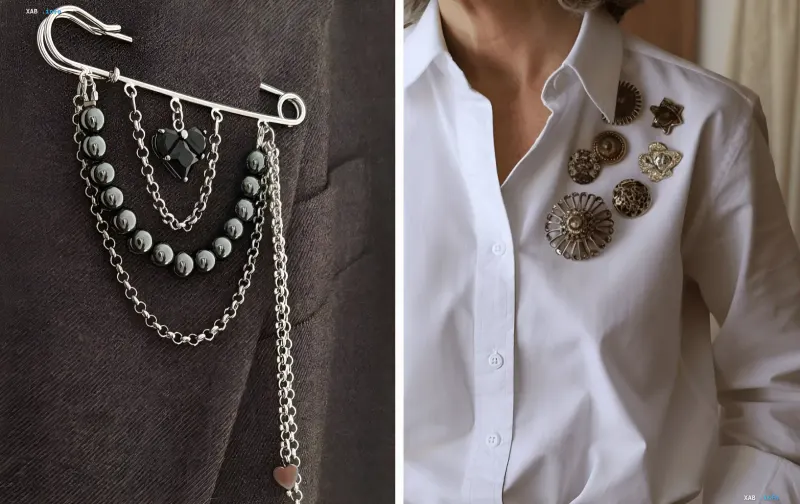
The simplest and most reliable option is to secure a brooch on the lapel of a jacket, but not as part of an office suit, but with a t-shirt, jeans, or wide-leg trousers. With a solid-colored sweater, the ornament works even better: stylists advise that it doesn't necessarily need to be centered; instead, shift it towards the shoulder or closer to the collarbone to turn ordinary knitwear into a more interesting look. In autumn, the brooch becomes an accent for outerwear as well—on the coat lapel, at the collar, or slightly below the shoulder: pair a contrasting metal ornament with a dark coat, and a colored or stone model with a light one.
Scarf, Shirt, and Non-Clothing Accessories
One of the most interesting tricks of the season is using a brooch not just for decoration, but to secure a scarf, especially a large woolen one; however, the model should not be too heavy to avoid stretching the fabric. An alternative to a traditional neck ornament is a small brooch at the collar of a white or blue shirt, which creates a clean background for a bright accessory. Finally, the brooch has long ceased to be an accessory exclusively for clothing: it is attached to a belt or a bag flap, which is especially suitable for those who want to add a bright detail to a basic look but don't like wearing too many ornaments.
How Not to Overload the Look: The Rule of Contrast and Combination
A brooch can be combined with earrings, rings, chains, and even glasses—such a combination looks effective but requires restraint in other elements: if the brooch is large and noticeable, other ornaments should be minimalist. To ensure the ornament doesn't 'add age,' stylists warn against automatically combining it with all classic items simultaneously—a severe suit, a pearl necklace, a midi skirt, and shoes of one style. Contrast works more modernly: a vintage brooch with jeans, a classic ornament with an oversized sweater, or an elegant model with a simple white shirt.
Contradictory Data
There are slight discrepancies in the details among recommendations from different publications. While Styler and glavred.info emphasize shifting the brooch from the center (towards the shoulder or collarbone) and contrasting it with the base, reviews from Kleo and m24 more often describe the brooch as a 'universal accessory' without such a strict requirement for asymmetry, offering central attachment on the lapel as a full-fledged option. Also, sources differ in their assessment of the allowable weight of a brooch on a scarf: Styler explicitly warns against 'too heavy' models, while some reviews limit themselves to a general recommendation to consider fabric density. These differences do not contradict the general trend, but when choosing an accessory, one should consider the material density and the balance of the entire look.
Thus, in Autumn 2026, a brooch is not a museum accessory but a working tool for a stylist: from a coat lapel to a bag flap, it can turn a boring base into a finished look, provided the rule of contrast is followed and the silhouette is not overloaded with classicism.