
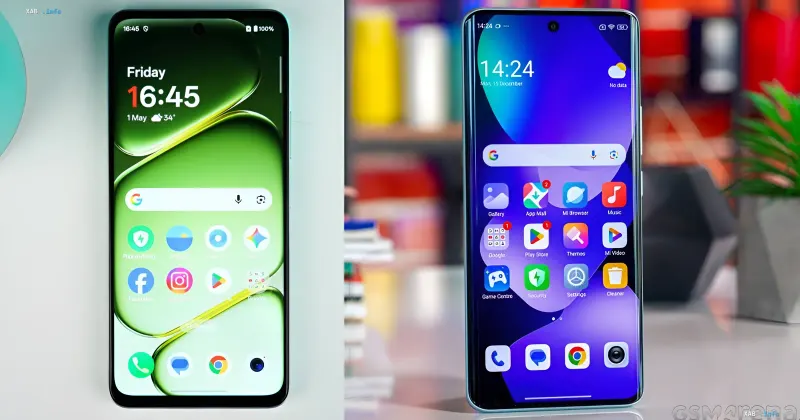
The smartphone market in 2026 offers users a wide selection of devices where price does not always determine quality. Two of the most discussed representatives of the mid-range segment — the OnePlus Nord CE 6 Lite and the Redmi Note 15 — have become the subject of a detailed comparison on the Gizmochina portal. Experts have dissected the new releases, revealing the key advantages and disadvantages of each device. Let's figure out which of these gadgets deserves your attention.
Display and Design: A Victory for Technology
Appearance and screen quality are the first things that catch the eye. The Redmi Note 15 immediately presents itself as a more modern device. Its body is distinguished by elegance and a slim profile, while a modern fingerprint scanner is hidden under the screen. Water resistance is also higher here — IP66 standard versus IP64 for the competitor.
Redmi's main weapon is its 6.77-inch AMOLED panel. With a peak brightness of 3200 nits, HDR10+ support, and high-frequency PWM dimming at 3840 Hz, this screen looks simply magnificent. The image is vibrant, the black color is deep, and visibility under direct sunlight remains excellent.
In contrast, the OnePlus Nord CE 6 Lite offers a more practical but technically inferior approach. The body has MIL-STD-810H military certification, indicating its reliability, but the fingerprint scanner here is side-mounted. The screen is made using IPS LCD technology. Despite the high refresh rate of 144 Hz, it cannot boast the same richness and contrast as its AMOLED competitor.
Verdict: An unequivocal victory for the Redmi Note 15. The AMOLED panel and brightness headroom make it the best choice for watching videos and browsing the web.
Performance and Battery Life: Power vs. Balance
If Xiaomi wins in the screen department, then in terms of "hardware," OnePlus takes the initiative. The Nord CE 6 Lite is equipped with the MediaTek Dimensity 7400 Apex chipset and a fast UFS 3.1 storage drive. This combination provides a noticeable advantage in operating speed and gaming performance.
Special attention deserves the OnePlus battery with a capacity of 7000 mAh. This is a real "power bank" that allows you to forget about charging for more than a day. Gamers will appreciate the Bypass Charging function, which powers the processor directly from the network, minimizing battery heating.
The Redmi Note 15 runs on the Snapdragon 6 Gen 3 platform with UFS 2.2 memory. This is sufficient for social media, work, and light gaming, but in a direct speed comparison, it loses. The 5520 mAh battery also ensures a confident day of operation, but against the giant from OnePlus, this figure looks more modest.
Verdict: OnePlus Nord CE 6 Lite wins thanks to its powerful platform, fast memory, and phenomenal battery life.
Cameras: Versatility vs. Compromises
In terms of photo capabilities, the advantage shifts back to the Redmi Note 15. The device offers a balanced set: a main module with optical stabilization (OIS), an ultra-wide-angle lens, and a quality front camera.
The OnePlus Nord CE 6 Lite looks cut down here. The 50 MP main camera lacks optical stabilization, and instead of a full-fledged ultra-wide lens, a dummy sensor is installed. Although the device is capable of recording video in 4K and 1080p at 120 frames per second, the lack of versatility seriously limits shooting scenarios.
Verdict: Redmi Note 15 wins thanks to OIS, the presence of an ultra-wide sensor, and a better front camera.
Final Choice
For most users, the Redmi Note 15 will be the more justified purchase. This is a gadget officially available in Ukraine with a superb screen, excellent camera, NFC, IR port, and a guarantee of Android updates for another 3 years (up to version 19).
The OnePlus Nord CE 6 Lite is a specialized tool. It should be considered only if battery life on a single charge and maximum gaming performance are critically important to you, and you are willing to sacrifice screen quality and camera versatility.


