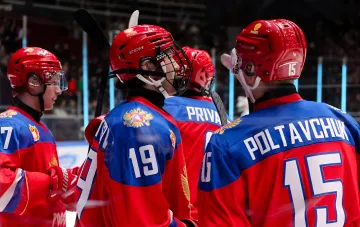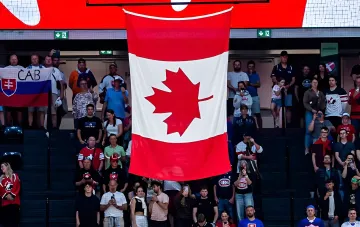

The Canadian government has officially notified the International Ice Hockey Federation (IIHF) that it will not issue visas to players of the Russian national team. This decision effectively deprives the Russian team of the opportunity to participate in the World Junior Championship, which kicks off on December 26 in Edmonton and Red Deer, despite a recent ruling by the Court of Arbitration for Sport (CAS) that lifted Russia's suspension from international tournaments.
Suspension lifted by CAS ruling
In late October, the CAS ruled that there were no longer grounds to continue the suspension of the Russian national team, which had been imposed following the Russian army's invasion of Ukraine in 2022. The decision took effect immediately, and the first major tournament that the IIHF was obligated to allow Russians into was the World Junior Championship.
IIHF attempted to comply with the court ruling
The Federation criticized the CAS ruling but declared its intent to comply. In early November, the IIHF sent an official letter to national federations stating that the Norwegian national team—the lowest-ranked team—had been excluded from the participant list, with the Russian national team taking its place. Simultaneously, the inclusion of Russians was condemned by the federations of Canada, Sweden, Finland, Germany, the Czech Republic, Latvia, and other influential hockey nations, while major sponsors threatened to terminate contracts with the international federation.
The visa barrier: why CAS is not binding on sovereign states
On November 11, it became known that the Canadian government had sent an official notice to the IIHF refusing to grant visas to Russian players. Unlike international federations, sovereign states are not required to heed CAS rulings, and this legal nuance proved decisive for the outcome.
The Russian Hockey Federation's pre-prepared plan failed
In Russia, a visa refusal had been anticipated from the start, and the Russian Hockey Federation (RIHF) had prepared in advance: according to Sport-Express, there were plans to form a roster exclusively from players in North American clubs, going as far as securing agreements with support staff, including skate sharpeners. However, Ottawa stated that even such players would not be able to play for the national team, as their work visas do not allow for it. On November 10, the RIHF sent a letter to the IIHF demanding that Russia's participation in the tournament in Canada either be publicly confirmed or moved to another country.
Can the IIHF strip Canada of hosting rights?
Formally, as noted by Sports.ru, the IIHF has the right to strip Canada of its right to host the championship: according to the regulations, the host country is obligated to "facilitate the issuance of visas," and for failure to do so, the federation can impose a fine, strip the country of the tournament, and ban it from bidding for future events. Nevertheless, according to the Canadian publication Hockey News, it is most likely that the IIHF will announce that the World Junior Championship will proceed in the originally planned format—with Norway and without Russia—explaining to the CAS that the actions were forced due to the refusal of Canadian authorities and the impossibility of changing the venue on short notice.
What will happen with subsequent tournaments
The prospects for Russia's participation in future competitions remain uncertain. In January, the Women's World Junior Championship will be held in the Czech Republic, and that country has also stated it does not wish to allow Russians to enter. In late April, the Men's World U18 Championship will take place in the USA, where the chances for Russians are likely higher—neither the American federation nor the US authorities have publicly spoken out against it. The main tournament of the year—the Men's World Championship—will take place at the end of May in Germany, where the government has already expressed disagreement with Russia's admission and allowed for the possibility of withdrawing from hosting the championship, whereas the "Alternative for Germany" and "The Left" parties have publicly called on the authorities not to obstruct the Russian team.