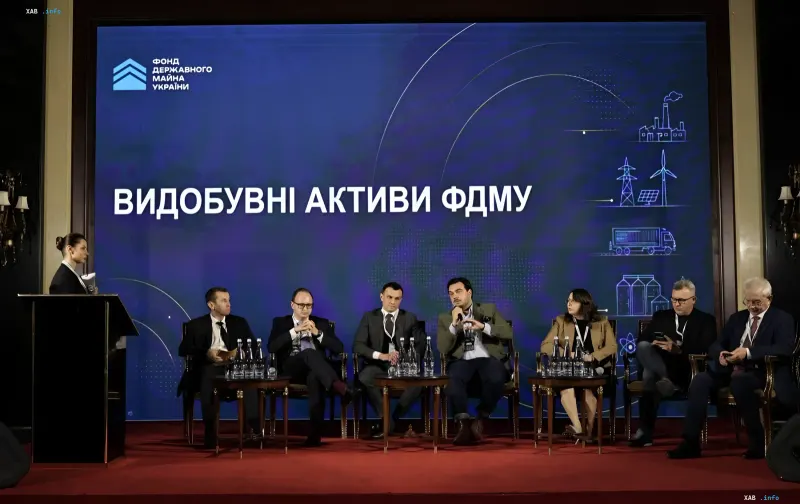
On October 1, 2026, the large-scale United by Mining conference took place in Kyiv, bringing together key players of the extractive industry, business representatives, specialized associations, and government agencies. Participants focused on the most acute sector problems, including state regulation, rising energy resource costs, complex logistics, and a critical shortage of qualified personnel. The discussion also centered on attracting investment, developing exploration, and launching new strategic mining projects.
State Regulation and Raw Material Independence
A particular resonance at the conference was sparked by the discussion on developing domestic raw material processing instead of simple export. Oleksandr Semak, Director of the Holovynskyi Trading House, supported the legislative initiative to introduce export duties on unprocessed construction and decorative stones, which has already passed its first reading in parliament. Ksenia Orinchak, Head of the National Association of Extractive Industries of Ukraine, emphasized that the country must focus on deep processing of unique resources. Additionally, it became known that the state budget for the current year allocates 186 million hryvnias for the development of the mineral resource base. Serhiy Vlasenko, Acting Head of the State Service of Geology and Mineral Resources, clarified that these funds will be directed to exploration, studying underground resources, and updating geological information.
Investment Potential and Disputes Over Assets
The topic of working with arrested and sanctioned assets sparked a lively discussion among market participants. State Property Fund Head Dmytro Natalukha stated the high attractiveness of such objects for investors due to significant discounts during sales. At the same time, Serhiy Ustenko, co-owner of Carpathian Mineral Waters, expressed the opinion that strategic investors are not interested in simple management of arrested property due to risks and insufficient security, preferring direct privatization. In response, Ksenia Orinchak noted the importance of an open dialogue between the state and business to overcome such differences and effectively replenish assets.
Energy Pressure and the Personnel Crisis
Tax and tariff burdens remain a serious challenge for industry. Ruslan Illichov, General Director of the Federation of Employers of Ukraine, demanded that the government intensify negotiations with the EU on abolishing the Carbon Border Adjustment Mechanism (CBAM) for Ukrainian enterprises due to force majeure circumstances caused by the war. Serhiy Skorbun, Head of External Projects at Metinvest, pointed out the unacceptable nature of solving the financial problems of Ukrenergo and Ukrzaliznytsia at the expense of large industrial consumers. Lyudmyla Onyshchenko, Chair of the Board of the Marganets Mining and Processing Plant, spoke about the difficult situation on the ground: the enterprise, located near the front line, is idle, and its main task is retaining personnel and securing mobilization deferrals for the remaining specialists.
Contradictory Data
During the discussion on ways to restore the mining industry, discrepancies emerged regarding approaches to working with state and arrested property. State agency representatives, specifically the State Property Fund and ARMA, rely on temporary management and attracting investors through lease mechanisms or discounted sales. However, the commercial sector, represented by the management of large production companies, insists that arrested assets require too much security costs and do not attract serious long-term players who are ready to invest only in full privatization and transparent rules of the game.
Prospects and New Projects
Despite crisis phenomena, companies continue to develop long-term initiatives. Vita Hizhniak, Head of Foreign Economic Activity at BGV Group Management, reported progress in implementing the BGV Graphite project: the feasibility study has been completed, and the design of the mining and processing complex is underway, with graphite concentrate production scheduled to start in 2029. At the same time, Ihor Chudyk, Rector of the Ivano-Frankivsk National Technical University of Oil and Gas, spoke about close cooperation between the university and business in training personnel, while Ksenia Orinchak announced the launch of educational initiatives in social networks to popularize mining professions among young people.