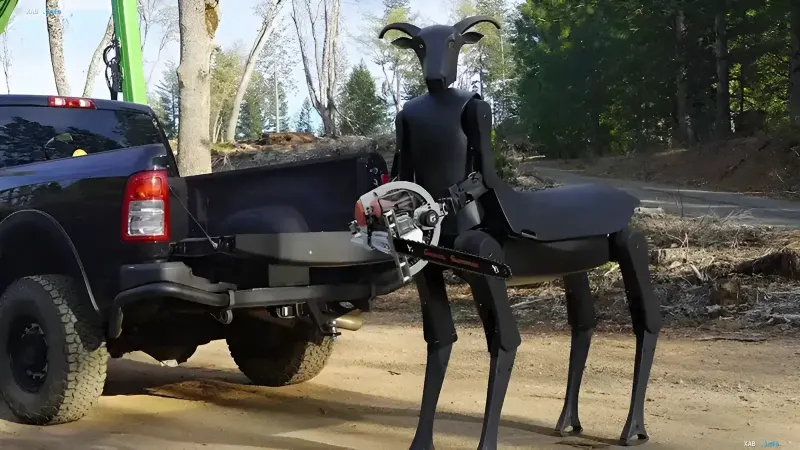
In the world of robotics, increasingly unexpected solutions are emerging for working in extreme conditions. California startup Satyress has unveiled a prototype of a remotely controlled robot called Threehalves. Externally, the device resembles a mythical centaur: a human torso is mounted on a platform with four legs. The height of the unit is about two meters.
Design and Mobility
Developers created the robot for use in locations where human presence involves high risk. The four support legs are designed to ensure stability on rough terrain and among debris, where wheeled vehicles might get stuck and bipedal machines could lose their balance.
A key feature of Threehalves is its modular limb system. Instead of fixed arms, the robot uses interchangeable modules, allowing the configuration to be changed in a few minutes to suit a specific task. The arsenal can include a chainsaw, a drill, or a screwdriver. Such component unification also simplifies repairs in the field.
Control and Safety
At the current stage, Threehalves is not an autonomous device. The operator controls the robot's movements from a safe distance using a joystick. However, engineers have designed several levels of emergency shutdown for the powerful machine.
The gesture recognition system allows the robot to be stopped if the operator raises their palm. As a last resort, high-pressure cylinders are mounted on the body. They can be punctured with a knife or shot, after which the system releases pressure and mechanically immobilizes the unit. Additionally, brakes are provided to lock mechanisms in the event of power loss or pressure drop in the pneumatic system.
Logistics and Prospects
Despite its impressive dimensions, the robot is designed to fold conveniently for transport. According to the developers, two units can fit side-by-side in the bed of a pickup truck about 1.7 meters long.
However, Satyress has not yet revealed key technical specifications: weight, payload capacity, speed, battery life, and communication range. The degree of protection against water, dust, smoke, and high temperatures is also unknown. The price, mass production timelines, and certification results remain secret.
Development Context
The Threehalves project fits into the general trend of developing machines with bionic designs. Alongside bipedal robots, quadruped platforms are actively evolving. Chinese engineers have advanced from robot dogs to robot horses, while the Japanese are creating quadruped motorcycles for off-road use. As practice shows, nature has offered an optimal solution for moving across complex terrain, which engineers are now actively adopting.