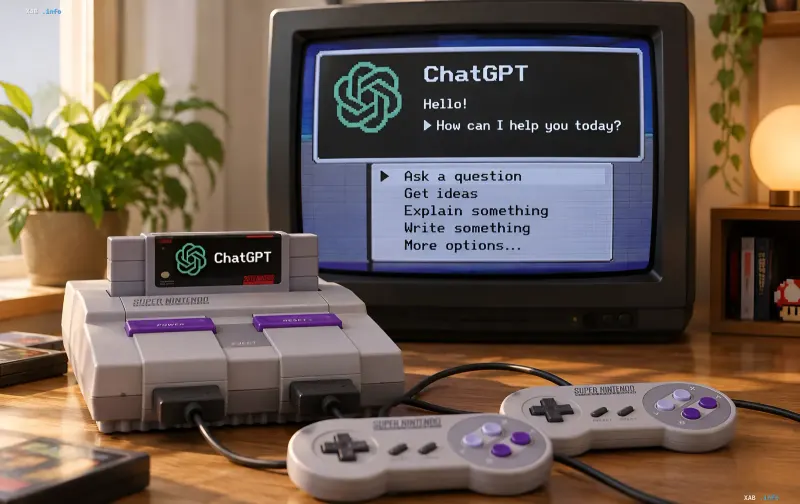
Tech journalist Benj Edwards has unveiled an experimental project bringing the popular ChatGPT chatbot to the Super Nintendo Entertainment System platform. The result is a compact language model with 2.2 million parameters, packaged as a ROM file capable of running both in an emulator and on original 90s hardware. According to the author, this is not a fully functional assistant for daily tasks, but rather a demonstration of how far modern AI technologies can be compressed to fit the constraints of legacy hardware.
How the Miniature Model Works
The project is built on the method of distillation — transferring the knowledge of a large language model into a significantly smaller one. Edwards used OpenAI's GPT-OSS-120B model to generate training dialogues, which were then used to train the compact version. The final model contains just 2.2 million parameters and a vocabulary of about 8,000 words. This is millions of times smaller than the base models powering modern ChatGPT, which inevitably affects the quality and accuracy of the responses.
Running on Original Hardware
The project can be run in an emulator or loaded as a ROM file. To run it on a real Super Nintendo, a special cartridge supporting the Super FX graphics coprocessor is required — such as the FXPak Pro or SD2SNES. The version with a built-in fact reference book additionally requires support for the Media Streaming Unit 1 (MSU-1) extension, which gives the console CD-ROM-like capabilities; both mentioned flash cartridges support this extension. According to Edwards, the base version can run without the Super FX chip, but due to lower processing power, the response quality will be lower. With appropriate skills, the project can theoretically even be run from a homebrew cartridge.
Limitations and "Almost Cute" Errors
The model frequently makes mistakes, sometimes doing so with considerable confidence, and inaccuracies can even be found in the built-in reference database. However, the author considers the funny and illogical responses part of the concept: thanks to the limited knowledge and playful retro interface complete with characteristic SNES-era sounds, the model's errors look "almost cute." Thus, the project is positioned not as a productive tool, but as an entertaining and exploratory research experiment.
Project Context and Previous Work
Edwards shared that he has been interested in such tech experiments since the 1990s and has been developing the concept of tiny conversational machines over the past year. For this project, he defined the program's scope, general operational logic, chip selection, interface, and typing sounds, while the code itself was written by AI agents. Previously, the author created a ROM for the original Nintendo Entertainment System called Séance featuring an even smaller model simulating conversation with a ghost inside a cartridge. Although the AI agents that helped write the code for running ChatGPT on SNES "believe" that the limits of such hardware have been nearly reached, Edwards disagrees and is already working on new ideas to make miniature language model responses more coherent and logical.