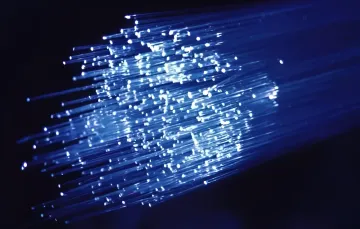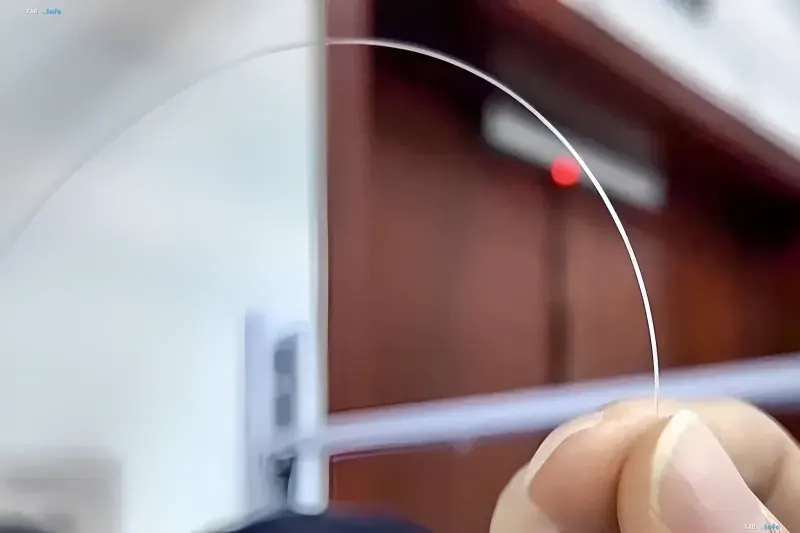
When all hardware capabilities for increasing data transfer speeds and reducing latency are exhausted, hidden reserves come into play. One of them is Hollow Core Fiber (HCF): light travels through its gas-filled core at a speed close to the speed of light in a vacuum, which is about a third faster than in conventional glass. It was on this type of fiber that Chinese researchers conducted the first publicly known trial of a communication line exceeding 1000 km, setting a world record for data transmission distance using a hollow core.
First 1000-kilometer experiment
A reminder that the technology is already operational came last year: Microsoft began using HCF fiber to connect its data centers over distances of up to 50 kilometers. The Chinese experiment has taken the technology to a fundamentally new scale. Three parties participated in the test: the China Telecom research institute, fiber optic cable manufacturer YOFC, and ZTE, a telecommunications equipment manufacturer. The joint team deployed an experimental line 1007.48 km long.
Important caveat: laboratory array, not a backbone
A key detail to consider when evaluating the result: the line was not a trunk line laid in the ground or through the air. It was a laboratory-assembled array of more than 300 fiber optic coils, each containing 2 to 5 km of fiber. Moreover, the deployment used standard, commercially available telecommunications equipment, making the result reproducible and practically significant, rather than purely academic.
128 Tbps total and 3.43 ms latency
Data was transmitted simultaneously in both directions over a single fiber at a speed of 64 Tbps in each direction, meaning the total throughput reached 128 Tbps. The one-way latency over 1000 km was 3.43 ms, compared to approximately 5 ms for transmission over conventional solid-core fiber. This reduction in latency by hundreds of percent in relative terms is significant for high-speed computing and networking applications.
How gas absorption was overcome
The main technical challenge was to suppress light absorption in the operating wavelength ranges caused by gases within the core, particularly carbon dioxide and carbon monoxide. Improved fiber manufacturing technology made it possible to solve this task and bring losses to a level acceptable for transmission over a thousand kilometers.
Strategic context: "Eastern Computing for Western Data"
Unlike Microsoft's experience, which focused on relatively short distances between data centers, Chinese developers are implementing this project specifically for backbone data lines, where the benefits of a hollow core will be maximized — including for transmitting data for artificial intelligence systems and handling large volumes of information. This fits into the national "Eastern Computing for Western Data" strategy: powerful computing clusters are being created near energy generation sources, many of which are located in the east of the country, while data is primarily generated in centers of business and scientific activity in the west. Under such conditions, increasing the throughput of backbone lines "from scratch" — without laying new cables — takes on strategic importance.