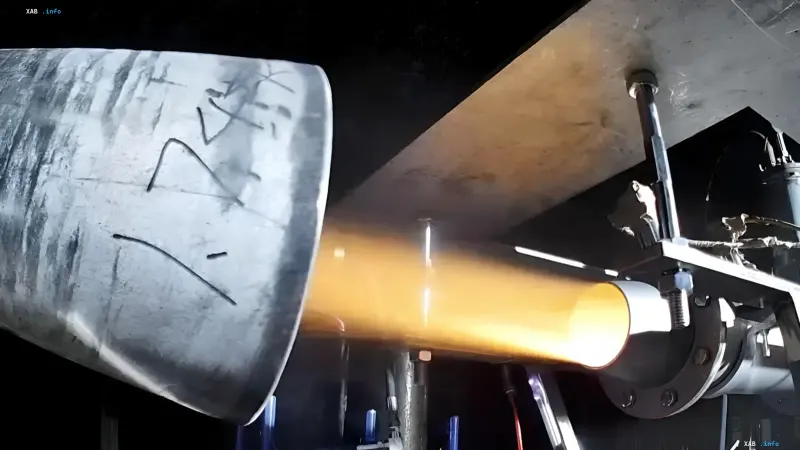
Chinese researchers have conducted the first hot-fire tests of a turbofan engine prototype in which the afterburner runs on metal powder instead of aviation kerosene. Developed by Nanchang University of Aeronautics, the concept aims to provide a new method for temporarily boosting jet engine thrust without traditional liquid fuel injection into the exhaust gas stream.
Four Years of Work and Bench Testing
The project was carried out over four years with the support of the Jiangxi Provincial Regional Research and Development Program. According to Chinese state media, bench tests on a specialized rig successfully started the engine and brought it to specified operating parameters. Thus, the key objective of this phase—validating the core concept of metal powder combustion in an afterburner—has been declared achieved.
How Conventional Afterburners Work
In classic turbojets and low-bypass turbofans, the afterburner is located downstream of the turbine. Additional aviation fuel is injected into it, burning in the hot exhaust gas stream using leftover oxygen. This allows for a short-term, significant increase in thrust—for example, during heavy-load takeoffs, rapid climbs, or acceleration to supersonic speeds. The drawback of this setup is high kerosene consumption and energy efficiency limitations.
Metal Powder as an Alternative to Kerosene
Chinese engineers propose replacing liquid fuel with fine metal particles, specifically aluminum or magnesium. These materials possess high volumetric energy density and are already studied for solid rocket motors and experimental ramjet installations. Bringing this idea into the afterburner of a turbofan engine represents the core novelty of the prototype.
Laboratory Prototype Without Public Specifications
The development was led by Sun Haijun from the School of Energy and Power Engineering at Nanchang University of Aeronautics. At this stage, the project involves a laboratory prototype and ground testing: public data regarding thrust, fuel consumption, engine lifespan, and potential implementation on real aircraft have not been disclosed. Practical deployment, if it happens, still faces several unresolved engineering and durability questions.