The Ministry of Commerce of the People's Republic of China officially refuted on Wednesday claims by US intelligence agencies that leading Chinese artificial intelligence firms were extracting confidential information from American laboratories "on an industrial scale." In Beijing, the accusations were called baseless, and officials emphasized that China is ready for "constructive and professional discussions with the United States within the framework of a dialogue based on the principles of equality and mutual benefit, cooperation and mutually beneficial outcomes." At the same time, a ministry spokesperson added that should Washington adopt measures to contain or suppress Chinese AI companies, "China will resolutely take countermeasures."
Joint Statement by US Intelligence Agencies: List of Accused Companies
On Tuesday, the US National Security Agency, the Federal Bureau of Investigation, and the Cybersecurity and Infrastructure Security Agency released a joint statement detailing which specific American systems were, according to them, copied by Chinese companies and for what reasons. The document specifically names six entities: DeepSeek, Moonshot, Alibaba Group Holding Ltd., MiniMax, StepFun, and Z.AI Co. Previously, American AI companies, including OpenAI and Anthropic PBC, as well as representatives of the Donald Trump administration, had repeatedly accused Chinese corporations of stealing models using a technique known as distillation.
Beijing Characterizes Distillation as a "Common Practice"
In response to the accusations, China's Ministry of Commerce characterized the distillation process as a "common practice" used by AI developers around the world to learn from one another. Moreover, the Beijing ministry suggested that it may in fact be American AI companies that use Chinese models as a foundation for their own developments. Thus, China not only rejects the accusations but also redirects them toward Washington, pointing to the symmetry of technological processes.
Contradictory Data
There is a fundamental discrepancy between the two sides in how they characterize the same process. US intelligence agencies describe the actions of Chinese companies as the theft of confidential information "on an industrial scale," i.e., as a deliberate and large-scale violation. The Chinese ministry, by contrast, calls distillation a "common practice" used by AI developers worldwide, thereby stripping the process of its criminal connotation. In addition, Beijing suggests that American companies also use Chinese models as a basis for their own developments, which contradicts the one-sided logic of Washington's accusations. These differences in interpretation make unambiguous verification of the facts impossible without an independent technical audit, which has not been conducted to date.
Context: Xi Jinping's Visit and the Intensification of Technological Competition
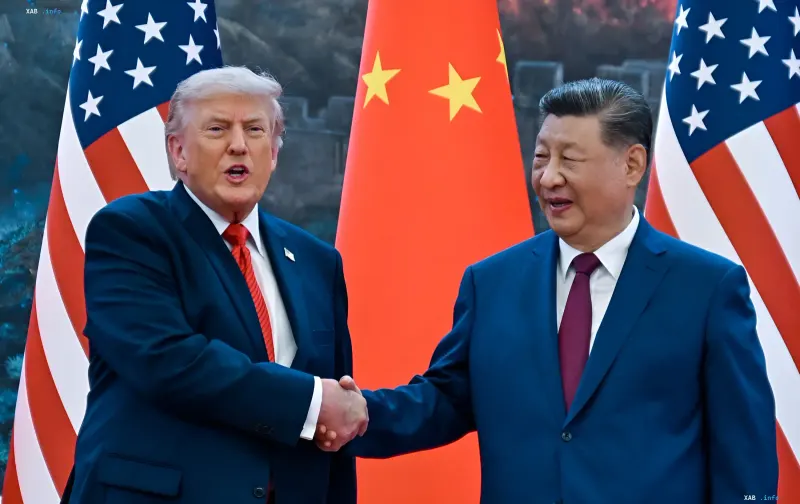
According to Bloomberg, the conflict over the theft of AI models heightened tensions between the two capitals just weeks before the head of the PRC, Xi Jinping, is due to arrive at the White House for a meeting with US President Donald Trump. Artificial intelligence has become a key area of technological competition between the two countries, as top Chinese models are actively narrowing the performance gap with leading American developments. Against this backdrop, on July 28 the media reported that the Trump administration plans to announce a ban on the import of new Chinese robots and inverters, which, according to Washington, is meant to protect the development of American AI from national security threats. A few days earlier, billionaire Elon Musk publicly called for not banning the use of Chinese AI models in the US, stating that such measures would not stop the technological progress of the East.