
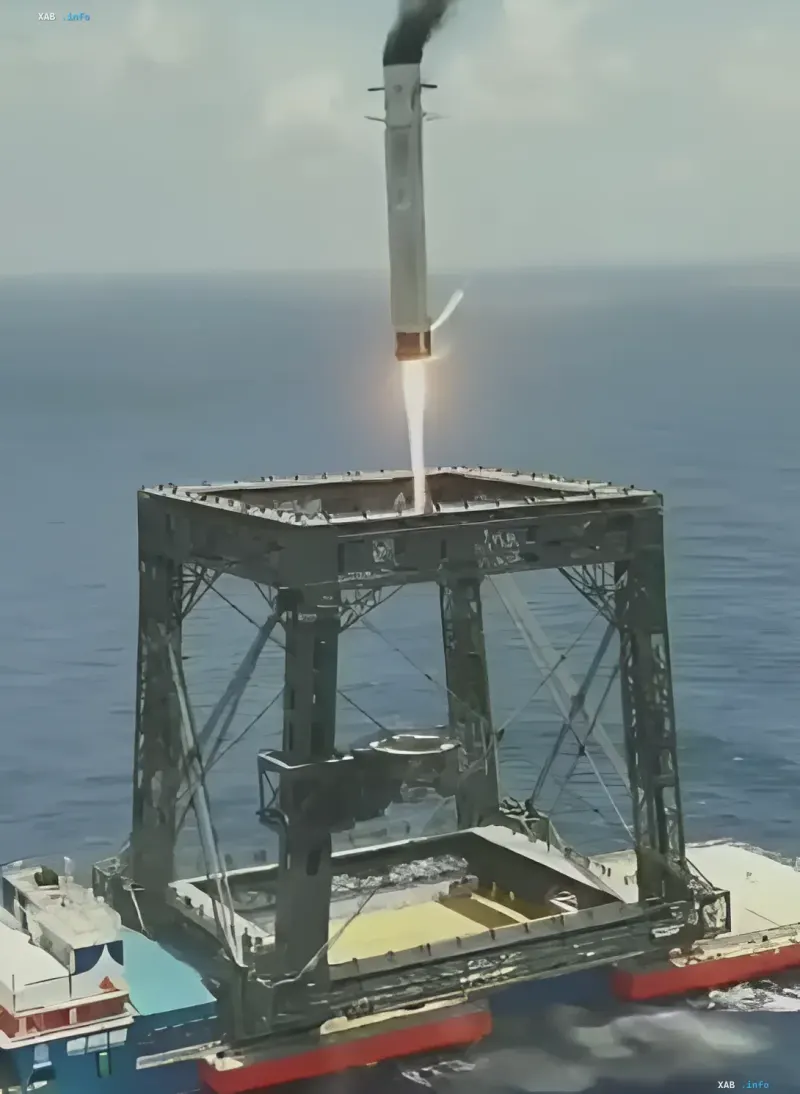
July 10, 2026, marked a landmark day for global spaceflight. The China Aerospace Science and Technology Corporation (CASC) successfully tested the return technology of the first stage of the 'Long March-10B' launch vehicle. The controlled vertical landing was carried out on a specialized sea vessel in the waters of the South China Sea. This event officially cemented China's status as the second country in the world to possess verified technologies for rocket booster return and reuse after payload deployment into orbit.
Unique technology: abandoning landing legs
The main intrigue of the mission was the demonstration of a fundamentally different approach to landing compared to Western counterparts. While the American company SpaceX relies on classic retractable landing legs for its Falcon rocket family, Chinese engineers chose an alternative path aimed at mass optimization.
During the descent, the first stage of the rocket did not deploy landing gear. Instead, the Net-Capture method was employed:
- At the final braking stage, the rocket's body-mounted hook-fixators latched onto a system of tensioned cables and capture nets.
- The fixation took place aboard the automated floating vessel 'Linhuan Zhe'.
- Abandoning heavy landing legs allowed for a reduction in the booster's dry mass, which directly increased the payload capacity per unit of fuel.
Technical specifications of the launch vehicle
'Long March-10B' is a medium-class two-stage launch vehicle with a total length of approximately 63 meters. The unit's launch thrust is approximately 890 tons. In a reusable configuration, the launcher is capable of delivering up to 16 tons of payload to low Earth orbit (LEO).
The rocket's power plant uses modern eco-friendly components: the first stage operates on a mixture of kerosene and liquid oxygen, while the second stage is equipped with an engine functioning on methane and liquid oxygen.
Strategic goals and future plans
According to internal CASC documentation, the returned stage has already been sent to the production and technical cluster. There, it will undergo defect detection and maintenance. A relaunch of this same stage is scheduled before the end of the fourth quarter of 2026.
The deployment of serial production of reusable modifications solves two key tasks for China:
- Economic efficiency: Reducing the cost of launching commercial payloads to form national multi-satellite communication constellations.
- Technological reserve: Refining components for super-heavy launchers, which will be required for the PRC's crewed lunar program, planned by 2030.
The implementation of vertical landing systems (VTVL) shifts China's space program into a new format. According to international standards, such technologies are classified as dual-use, as they ensure independent operational access to near-Earth space and allow for a multiple increase in the frequency of launch campaigns.


