
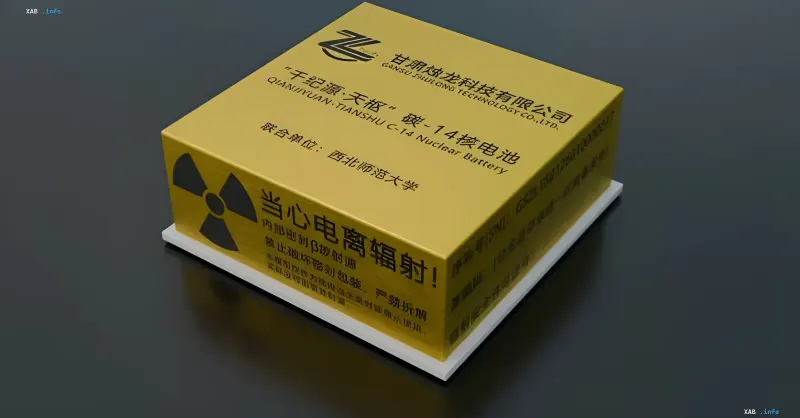
Chinese scientists and engineers have officially unveiled a next-generation radioisotope power source project named "Qianjiyuan Tianshu". The development was carried out by a team of specialists from the Northwest Normal University in collaboration with the commercial entity Gansu Zhulong Technology. The new device is based on the use of the Carbon-14 isotope ($^{14}C$) and a silicon carbide ($SiC$) semiconductor converter. According to the developers, the technology demonstrates a significant increase in energy efficiency compared to the previous 2024 prototype ("Candle Dragon-I") and boasts a calculated service life of several thousand years.
Physics of eternal current: how betavoltaics works
The operating principle of "Qianjiyuan Tianshu" differs radically from classic radioisotope thermoelectric generators (RTGs). While traditional RTGs convert the thermal energy released during the decay of radioactive substances into electricity, the new Chinese device utilizes the betavoltaic principle.
The core of the technology lies in the direct capture of electrons (beta particles) released during isotope decay by a semiconductor matrix. This forms a directed electric current. The physical algorithm of the device's operation can be compared to photovoltaic panels: while solar batteries generate energy using light quanta, in "Qianjiyuan Tianshu", the energy source is ionizing particles.
Technical specifications and compactness
Engineers have managed to create a device with impressive power density figures while maintaining minimal dimensions. Thanks to the application of a three-dimensional multi-layer architecture, the total volume of the element was reduced by 17% compared to flat analogues, while the specific power density increased by approximately 15 times.
The key parameters of the prototype are as follows:
- Geometric volume: 16.8 cm³
- Isotope source activity ($^{14}C$): 129 mCi (4.773 × 10⁹ Bq)
- Output voltage: 2.06 V
- Current strength: 0.713 µA
- Peak power: 1.13 µW
- Share of radioactive material in the core: 22%
The power generation per unit volume increased by 2.6 times without loss of voltaic stability.
Safety and application prospects
One of the main advantages of using Carbon-14 is its physical nature. The half-life of this isotope is approximately 5730 years, guaranteeing long-term autonomy for the battery. Furthermore, beta radiation has low penetrating power. It is completely blocked by the protective shell of the element and the silicon carbide converter itself, reducing the external radiation background to natural levels.
Experts emphasize that current power figures (microwatt level) make it impossible to use such batteries to power high-consumption consumer electronics, such as smartphones or laptops. However, for specific tasks, this solution becomes revolutionary. Priority areas of application include:
- Deep space monitoring and telemetry systems;
- Autonomous sensors for inaccessible climatic zones or the seabed;
- Medical implants (e.g., pacemakers) requiring years of operation without the need for surgical replacement of power elements.
Production and regulation
At present, China is concentrating significant production capacity for the synthesis of the $^{14}C$ isotope and the creation of a closed chain for the production of wide-bandgap semiconductors. This allows all stages of the device assembly to be localized within the country.
However, the path to mass implementation lies through strict certification. According to IAEA international standards, the use of radionuclide sources in the civilian sector is strictly regulated. Industrial use of new-type betavoltaic elements will require confirmation of the hermeticity of protective barriers under various mechanical and thermal loads.


