
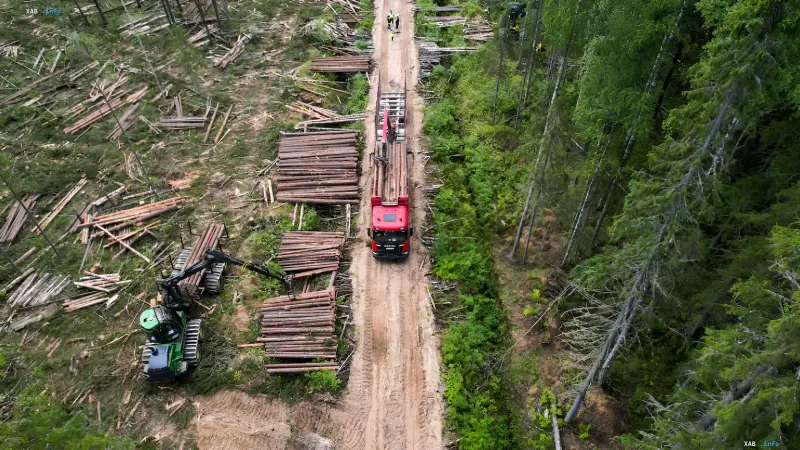
China, traditionally the main buyer of Russian timber, sharply reduced purchases at the beginning of 2026. According to the analytics company Lesprom Network, the physical volume of timber exports from Russia to China fell by 30% year-on-year between January and April. Over four months, only 2.6 million cubic meters of products were sent to the Middle Kingdom.
Prices are rising, volumes are falling
The situation in the market is characterized by an interesting paradox: the decline in revenue turned out to be less dramatic than the reduction in volumes. In monetary terms, exports decreased by 26%, amounting to $603.7 million. This discrepancy in figures indicates that average prices for Russian timber at the border are rising. Experts link this to increased logistics costs, which are passed on to the final cost of the goods.
The downward trend is gaining momentum. Looking at the statistics for April 2026 alone, the volume of supplies plummeted by 33% compared to the same month last year, reaching a mark of 759 thousand tons. This confirms the stability of the downward dynamics in the spring period.
Double blow: real estate crisis and banking barriers
Analysts highlight two systemic factors that have "strangled" demand for Russian forest industry products. The first is the internal situation in China. The real estate sector in China is in deep stagnation: developers are winding down investment programs, and housing construction volumes are falling. As a result, demand for primary construction and finishing materials, including coniferous and deciduous timber, is rapidly declining.
The second factor is the complication of financial operations. Since the beginning of 2026, major Chinese banks have tightened compliance procedures for payments from Russia. Fear of secondary sanction risks has led to an increase in transaction verification times and a rise in the share of payment returns. This creates serious difficulties for the regular work of medium and large exporters.
Crisis sweeps the entire Asia-Pacific region
Problems with China are only part of the bigger picture. A decline in imports is also recorded in other key Asian directions. In 2025, China accumulated about half of all Russian timber exports (11.2 million cubic meters), but now demand is falling everywhere:
- Exports to Japan decreased by 19%.
- Supplies to South Korea fell by 18%.
In conditions of sharp demand contraction in familiar markets, Russian forest industry companies are forced to find new ways. After the redirection of flows that occurred in 2022, enterprises are now considering alternative sales channels — in particular, the markets of India and the Middle East countries. At the same time, there is a process of optimizing production capacity for domestic consumption to compensate for losses from the external market.


