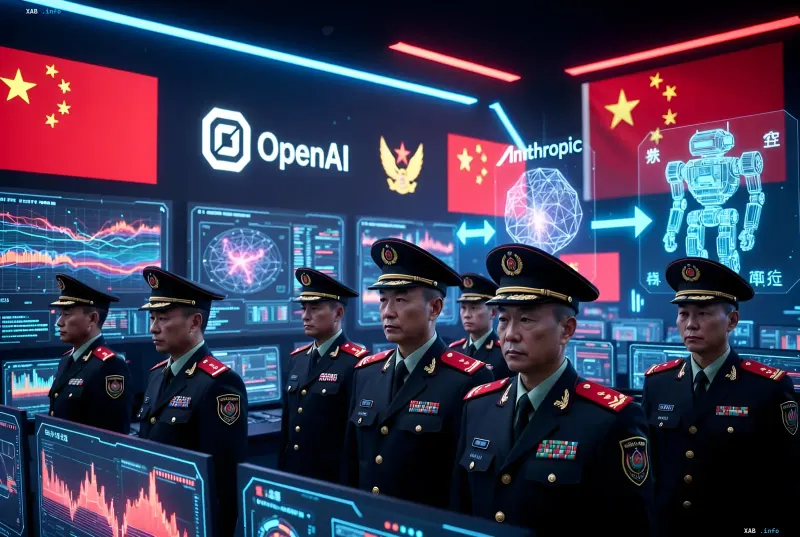
Military and research structures in China linked to the security apparatus are actively using the results of advanced language models developed by American tech giants — OpenAI and Anthropic. This is reported by Reuters, based on an in-depth analysis of more than 80 Chinese scientific publications and patents.
The "distillation" technology: how AI is copied
The key tool in this work has become a method known as model distillation. The essence of the technology is that the outputs of a powerful and resource-intensive AI model are used to train a more compact and specialized version. Such a "child" model is capable of running locally, requiring significantly fewer computational resources, while maintaining high efficiency in narrow tasks.
Reuters states that this approach was actively used by researchers with direct ties to the People's Liberation Army of China (PLA) and other military institutions. According to analysts, this strategy allows Beijing to accelerate the creation of its own artificial intelligence systems, avoiding the need to develop GPT-level models from scratch.
Geopolitical tension and accusations of rights violations
The issue of using the distillation method has become one of the most acute topics in the technological confrontation between the US and China. US authorities claim that some Chinese organizations are effectively extracting the capabilities of American models using this method, bypassing export restrictions and violating intellectual property rights.
Washington views such actions as a way to neutralize the technological superiority of the West in the field of AI, using foreign developments to strengthen its own military power.
Beijing's response: accusation of hegemony
China categorically rejects these accusations. In Beijing, US actions are called an attempt to establish "hegemony" in the field of artificial intelligence and limit the development of other countries. Local developers, including notable startups like Moonshot AI, insist that their achievements are based solely on their own technologies and innovations, not on borrowing foreign models.