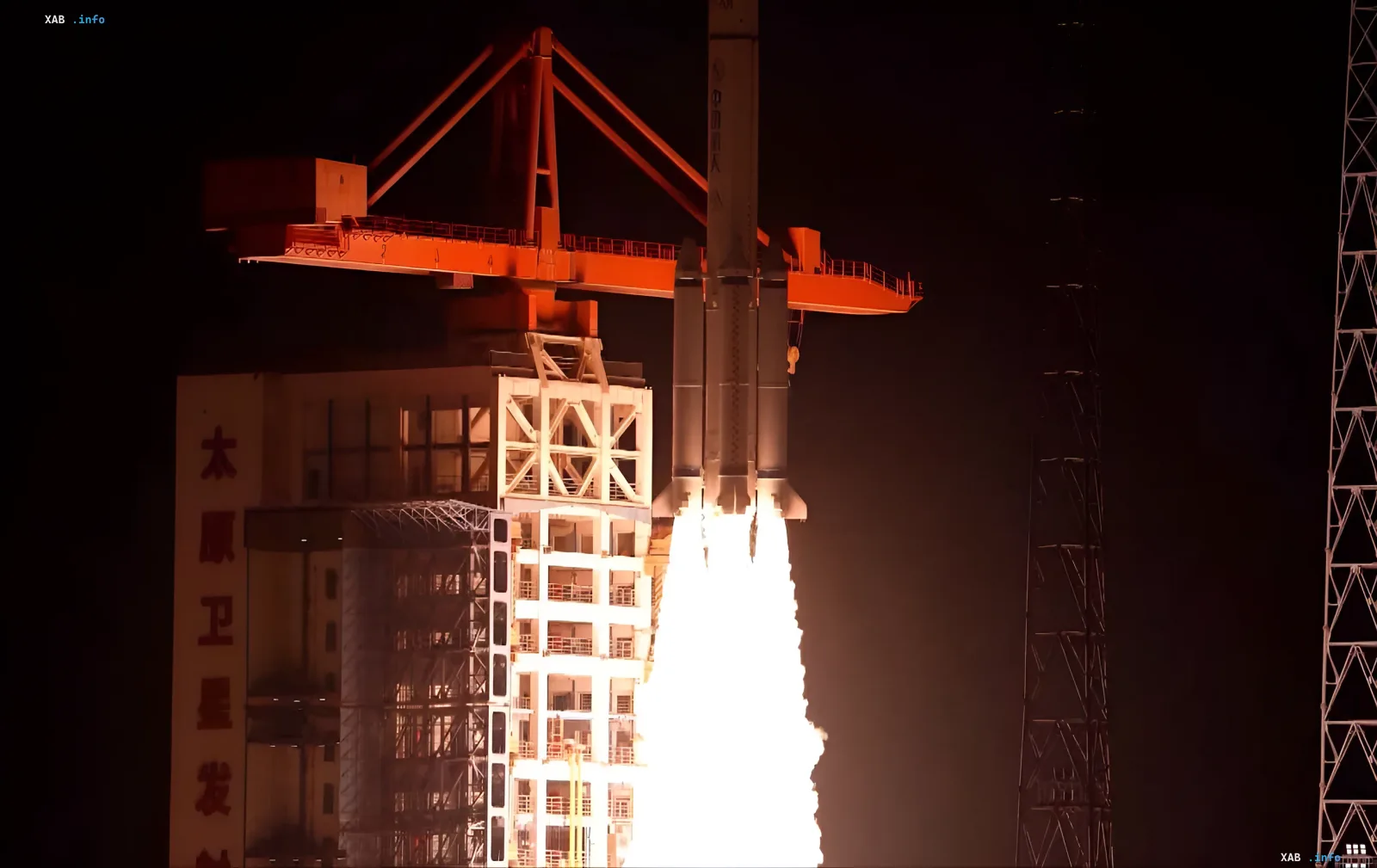
A new cloud of space debris has formed in low Earth orbit. According to Jonathan McDowell, a former astrophysicist at the Harvard-Smithsonian Center for Astrophysics, on September 4, 2026, the U.S. Space Forces detected at least 43 large fragments resulting from the unexpected breakup of the Chinese satellite Yaogan-50 (02). The spacecraft was launched into orbit on March 15, 2026, aboard a Long March 6A launch vehicle and successfully reached its working high retrograde orbit at an altitude of about 952 kilometers, meaning it traveled in the direction opposite to Earth's rotation. Approximately six months after the start of its mission, the spacecraft failed and, according to available information, was destroyed as a result of an unknown anomaly.
Debris parameters and orbital risks
According to published data, the satellite fragments are now distributed across an altitude range of 600 to 1,100 kilometers and retain an orbital inclination of 142 degrees. It is precisely this altitude that makes the breakup of Yaogan-50 (02) a global long-term problem: at these levels the atmosphere is too thin to quickly slow the debris down, so the fragments may remain in orbit for decades, posing a collision risk to operational satellites and stations. The retrograde trajectory further complicates the picture, since such orbits are less congested and are more poorly tracked within standard conjunction-assessment schemes.
Causes: expert theories
The exact cause of the breakup of Yaogan-50 (02) has not been established as of the time of publication. Among the main theories, experts cite a failure of the propulsion system or the battery, as well as a possible collision of the spacecraft with another piece of space debris. None of these hypotheses has yet been confirmed by official data, and Beijing has not publicly disclosed details of the incident, leaving room for various interpretations.
Contradictory data
A significant discrepancy exists in the assessment of the very purpose of the Yaogan-50 series. Official Beijing states that spacecraft of this series are intended for surveying land resources, assessing crop yields, and preventing natural disasters, that is, for civilian tasks. However, according to reports by SpaceNews, the Yaogan-50 series satellites are in fact used for military reconnaissance and intelligence gathering. Thus, one side insists on the peaceful nature of the mission, while independent media point to a dual, predominantly military, purpose. Moreover, a contradiction persists regarding the causes of the breakup as well: in the absence of an official finding, all the theories listed remain speculative.
Context: the scale of the space debris problem
The incident with Yaogan-50 (02) fits into a broader trend of debris accumulation in low Earth orbit. According to estimates by the European Space Agency, more than 660 such anomalies — explosions or collisions — have already been recorded in Earth orbit, and the total number of space debris objects exceeds 1.5 million. Each new breakup increases traffic density at popular and operational altitudes, which raises the load on tracking systems and requires satellite operators to perform additional avoidance maneuvers.


