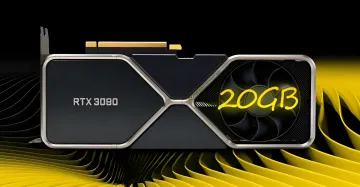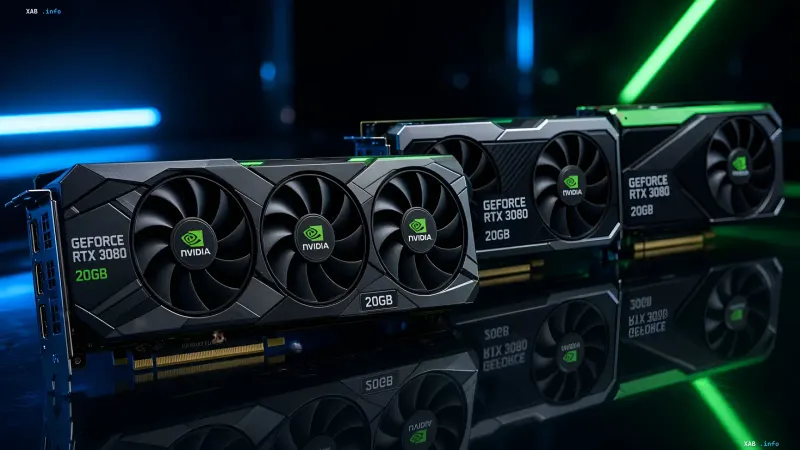
Against the backdrop of rapidly rising prices for current-generation Blackwell graphics cards, an unusual trend has been observed on the Chinese secondary market: local workshops have begun mass-resoldering older GeForce RTX 3080 cards, doubling their GDDR6X video memory from the factory 10 GB to 20 GB. The modified accelerators are already appearing on store shelves and online marketplaces at a price of around $445 (about 3,000 yuan), making them a notable alternative to new models whose prices have recently significantly exceeded the manufacturer's recommended levels. In essence, this phenomenon turns the outdated 2020 flagship into a tool suitable for modern games and generative AI tasks.
The Memory Resoldering Phenomenon and Its Causes
The key motivation for the technicians was to eliminate the main limitation of the original RTX 3080 — its modest 10 GB of video memory by modern standards. For most current AAA titles at high settings, and even more so for running neural network models locally, 10 GB of GDDR6X has already become a bottleneck. Doubling the capacity to 20 GB keeps the cards in demand for several more years without requiring the user to buy a brand-new accelerator. According to Chinese media, this is a mass rather than isolated phenomenon: entire workshops, not individual enthusiasts, are engaged in the resoldering.
The Technical Essence of the Modification and Its Limits
From a technical standpoint, the operation boils down to replacing the GDDR6X memory chips with ones of doubled capacity, which requires careful work with soldering equipment and re-flashing of the memory controller. At the same time, the modified card retains all the limitations of the original Ampere generation: high power consumption, lack of support for the DLSS 4.5 hardware frame generator, and other Blackwell architecture innovations. In effect, the buyer is not getting a new graphics card but an "upgraded" old one, which fundamentally changes expectations of performance in modern scenarios.
Price Appeal and Buyer Risks
The main argument in favor of such cards is the price. At a cost of around $445, the modified RTX 3080 with 20 GB looks significantly cheaper than new flagships, whose market prices in 2026 consistently exceed the recommended ones. However, behind this appeal lie substantial risks: the absence of an official manufacturer warranty, potential instability after resoldering, and uncertainty about component lifespan. The buyer effectively assumes full responsibility for the device's operability, which may be unacceptable for the mass consumer.
Contradictory Data
When cross-checking information from various sources, notable discrepancies emerge. First, the primary material lists the price of the modified cards at around $445 (3,000 yuan), whereas a publication on overclockers.ru reports that mining MSI GeForce RTX 3080 cards with 20 GB of memory are sold in China for $600. The $150 difference may be explained by differences in the condition of the cards (worn mining units versus workshop-modified ones), the specific board manufacturer, or the period in which prices were recorded. Second, one source (overclockers.ua) describes the find specifically as a "prototype" of the 20-gigabyte card, indicating an earlier stage of the phenomenon, while other materials already speak of mass production and sales. The chronological mismatch between a "prototype" and a "mass market" requires cautious interpretation: it is likely that different time slices of the same process are being discussed.
Impact on the Market and the Trend's Prospects
Mass resoldering of old cards sets a new vector on the secondary market: instead of simply reselling used accelerators, "upgraded" versions with altered specifications are appearing. If prices for new Blackwell-generation graphics cards remain elevated, demand for such modifications may only grow, and the practice of memory resoldering could spread to other models from previous generations. For NVIDIA and AIB partners, this is a potential signal: a significant portion of the audience is willing to accept compromises for the sake of savings, which could influence pricing policy and the product lineup in the future. The question of whether an ordinary user will risk buying a modified graphics card with doubled memory instead of a new expensive accelerator remains open and largely depends on trust in specific workshops and the availability of at least a minimal warranty.